
New York Disability Insurance, officially the New York Disability Benefits Law (DBL), pays eligible employees 50% of their average weekly wage, capped at $170 a week, for up to 26 weeks after a seven-day unpaid waiting period.
That $170 cap and 26-week limit come from New York Workers’ Compensation Law Article 9, not estimates or rough averages.
Most workers earning above entry-level wages hit that $170 cap well before it replaces half their pay.
New York Disability Insurance at a Glance: Benefits, Limits, and Eligibility
DBL is a legal floor, not full income replacement, and the eligibility rules below decide whether you qualify.
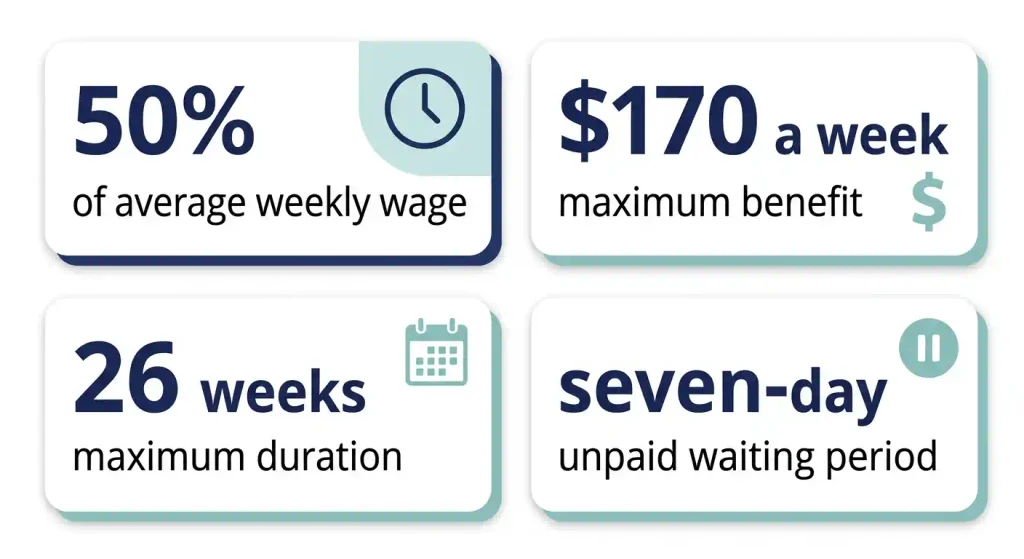
New York Disability Benefits at a Glance in 2026
Those limits trace to specific statutes: Workers’ Compensation Law § 204 sets the $170 weekly disability benefit maximum, § 208 sets the eighth-day start, and § 205 sets the 26-week cap. The New York State Workers’ Compensation Board oversees the program, but your employer’s carrier, or the employer itself if self-insured, pays claims. Workers’ Compensation Law § 209 caps your payroll contribution at one-half of one percent of wages, or 60 cents a week, usually labeled disability insurance or DBL on your pay stub. $170 is the statutory minimum. Pending bill S172 would raise it, but hadn’t passed as of 2026. Some employers buy enhanced plans through carriers like NYSIF, paying up to five times more. If you’re out more than seven days, your employer must give you Form DB-271S, a Statement of Rights naming your carrier.
Who Qualifies for New York Disability Insurance?
You qualify if you work for a covered New York employer and can’t work due to a non-job-related illness, injury, or pregnancy. Your doctor must certify in writing that it stops you from doing your job, not just makes it harder. On-the-job injuries go through workers’ compensation instead, and being merely unwilling to work doesn’t count.
How Much Does New York Disability Insurance Pay in 2026?
Most claimants hit the $170 cap fast. Earn more than about $340 a week, and your benefit maxes out at $170 no matter how much more you make. See our calculation methodology for how these paycheck figures are derived.
Weekly Benefit Amount and Maximum Payment
Your benefit is 50% of your average weekly wage over the eight weeks before your disability started, capped at $170. The first seven days are unpaid, so one week out gets you nothing. Payments start on day eight, up to 26 weeks within any 52 week period.
How to Calculate Your Estimated Disability Benefit
Add your gross wages from the eight weeks before you stopped working, divide by eight, then cut that number in half. Under $170, that’s your benefit. Over $170, you get $170. Someone averaging $400 a week gets $170; someone averaging $280 gets $140. The calculation starts from gross pay, not take-home pay.
Disability Benefit Examples by Weekly Income
$340 a week is the break-even point, half of that is exactly $170; below it, your benefit tracks your actual wage.
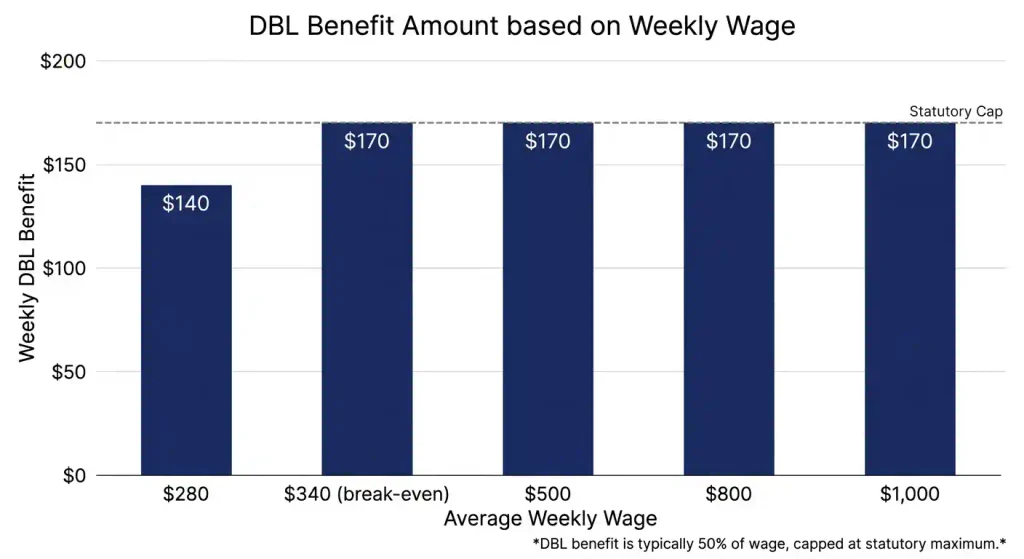
| Weekly Wage | Weekly DBL Benefit | 12-Week Total | 26-Week Total |
|---|---|---|---|
| $280 | $140 | $1,680 | $3,640 |
| $340 (break-even) | $170 | $2,040 | $4,420 |
| $500 | $170 | $2,040 | $4,420 |
| $800 | $170 | $2,040 | $4,420 |
| $1,000 | $170 | $2,040 | $4,420 |
For most workers, DBL is a safety net, not substitute income.
Are New York Disability Benefits Taxable?
Income tax depends on who paid the premium. Employer-paid premiums make benefits taxable; your own after-tax contribution portion usually isn’t. Mixed funding means mixed tax treatment. Social Security and Medicare taxes apply regardless of who paid, unlike Paid Family Leave, which typically skips FICA. New York generally mirrors the federal treatment on your state return. Ask payroll how your plan is funded. For a broader look at what taxes come out of a New York paycheck, see our full breakdown.
New York Disability Insurance Eligibility Requirements
Coverage is broad but not automatic or universal.
Which Employees Are Covered?
Nearly all private-sector employees are covered, and employers with one or more employees generally must carry coverage. Part-time, temporary, and seasonal workers qualify after 4 consecutive weeks (full-time) or 25 days worked (part-time). Domestic workers qualify at 20 or more hours a week for one employer, over at least 30 days a year. Coverage depends on where work is legally localized, not just where you live or your employer sits. Living in New York but working entirely out of state usually means no coverage; working remotely for a New York employer depends on your base of operations, so check with HR. Public employees aren’t automatically covered. Independent contractors and gig workers, along with the self-employed, generally aren’t covered unless they opt into a voluntary plan.
Which Illnesses and Injuries Qualify?
Off-the-job accidents, illnesses, surgery recovery, pregnancy, and mental health conditions all qualify, if a licensed provider certifies you can’t work. Where it started doesn’t matter, vacation, travel, or home, as long as it’s non-work-related and certified. Without a provider’s documented diagnosis, limitations, and timeframe, even a real condition won’t move a claim forward.
When Can a Claim Be Ineligible?
Work-related injuries go through workers’ compensation, not DBL. Elective procedures that aren’t medically necessary are typically excluded. Working for pay anywhere, even a different job, disqualifies those specific days, and carriers do check. A pre-existing condition doesn’t disqualify you on its own, as long as it newly stops you from working and your provider certifies that.
Does Your Employment Status Affect Eligibility?
Still employed, or within four weeks of your last day, you’re covered under your former employer’s policy. Unemployed more than four weeks, you file with the Special Fund for Disability Benefits instead. Quitting doesn’t erase eligibility, it just shifts where you file. Multiple employers or recent job changes mean checking both timing rules, since missing the four week cutoff changes the process.
New York Disability Insurance vs. Other Benefits
DBL, PFL, workers’ comp, SSDI, and FMLA cover different situations and don’t overlap.
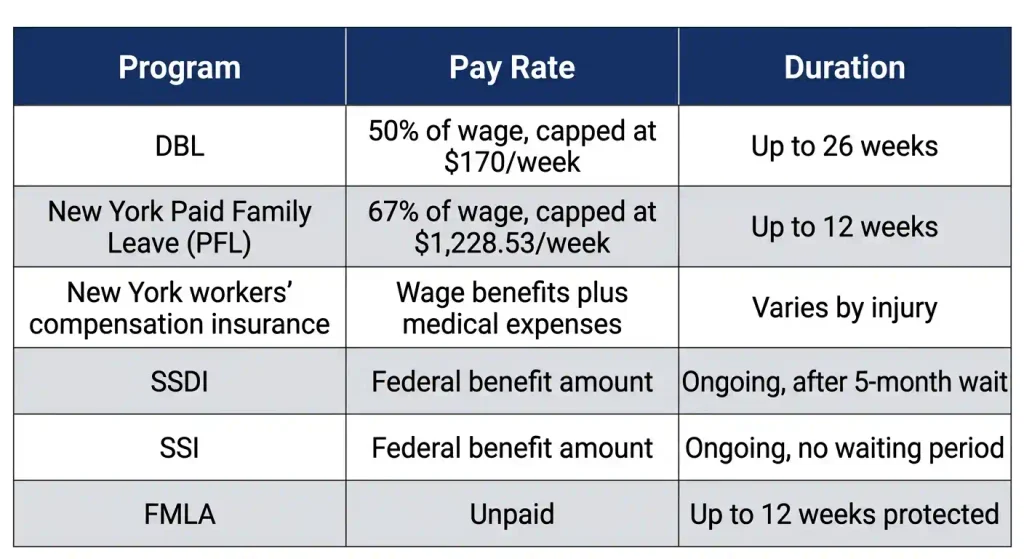
| Program | Covers | Pay Rate | Duration |
|---|---|---|---|
| DBL | Your own non-job-related illness, injury, or pregnancy | 50% of wage, capped at $170/week | Up to 26 weeks |
| New York Paid Family Leave (PFL) | Caring for a family member or bonding with a new child | 67% of wage, capped at $1,228.53/week | Up to 12 weeks |
| New York workers’ compensation insurance | On-the-job injury or occupational illness | Wage benefits plus medical expenses | Varies by injury |
| SSDI | Long-term or permanent disability, work-history based (federal) | Federal benefit amount | Ongoing, after 5-month wait |
| SSI | Long-term or permanent disability, needs-based (federal) | Federal benefit amount | Ongoing, no waiting period |
| FMLA | Job protection during leave | Unpaid | Up to 12 weeks protected |
Disability Insurance vs. Paid Family Leave
DBL covers your own illness or injury; New York Paid Family Leave (PFL) covers caring for a family member or bonding with a new child. In 2026, PFL pays 67% of your average weekly wage, up to the $1,228.53 weekly Paid Family Leave maximum, for up to 12 weeks, far above DBL’s $170. That cap moves yearly with the average weekly wage the New York State Department of Labor publishes. You can’t collect both at once, and combined they’re capped at 26 weeks in a 52 week window.
Disability Insurance vs. Workers’ Compensation
Off-the-job disabilities go through DBL. On-the-job injuries go through New York workers’ compensation insurance instead, which also covers medical expenses DBL doesn’t. Disputes over where an injury happened get sorted through the Workers’ Compensation Board, filing wrong can delay payment by weeks.
Disability Insurance vs. SSDI and SSI
DBL is temporary, capped at 26 weeks. Social Security Disability Insurance (SSDI) and Supplemental Security Income (SSI) are federal programs for long-term or permanent disabilities, with stricter requirements. SSDI’s 2026 cost-of-living adjustment is 2.8%, with a five month waiting period, far longer than DBL’s seven days. If your condition will likely outlast 26 weeks, start the SSDI application early; approval can take months.
Disability Insurance vs. FMLA and Private Disability Coverage
The Family and Medical Leave Act (FMLA) protects your job but pays nothing. DBL pays you, but the statutory minimum doesn’t guarantee job protection. Some employers add private short-term or long-term disability on top, paying more and longer. Many let you tap sick leave or vacation to cover the waiting period, check your handbook. Knowing which applies, sometimes more than one at once, determines your income and job security.
How to Apply for New York Disability Insurance Step by Step
Five steps: confirm coverage, get the form, complete it, submit it, track it.
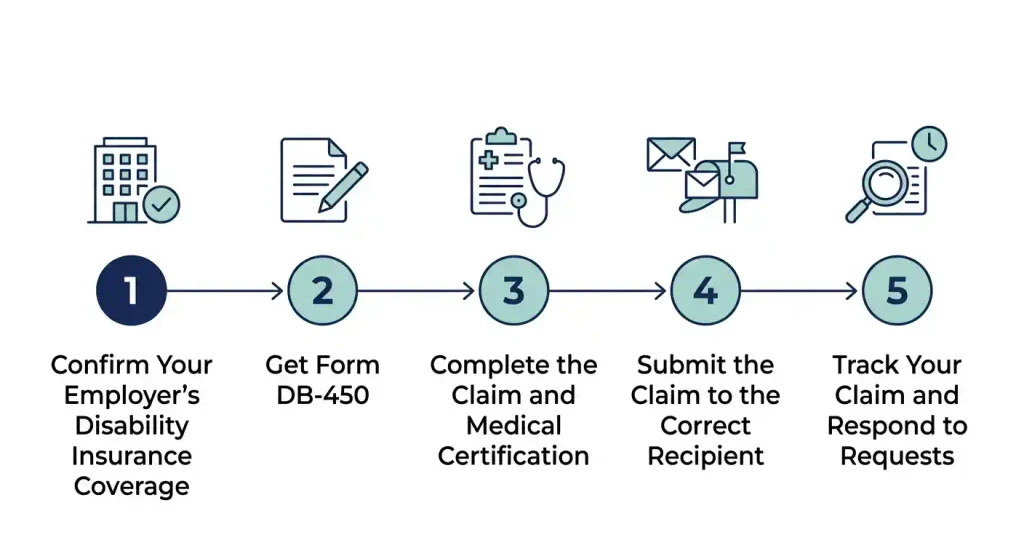
Step 1: Confirm Your Employer’s Disability Insurance Coverage
Find out who insures your employer’s DBL plan. HR or payroll should give you the carrier’s name and contact info. If not, the New York State Workers’ Compensation Board’s website has verification tools.
Step 2: Get Form DB-450
You need Notice and Proof of Claim for Disability Benefits, Form DB-450, from your employer, carrier, or the Workers’ Compensation Board at wcb.ny.gov. A car accident or third-party situation also needs Form DB-450.1.
Step 3: Complete the Claim and Medical Certification
The form has two parts: your personal and employment details, and your provider’s certification of diagnosis and limitations. Both must be complete, an incomplete medical section is a top reason claims stall. If either party hasn’t finished, follow up directly.
Step 4: Submit the Claim to the Correct Recipient
Employed, or within four weeks of your last day, send it to your employer or carrier. Unemployed more than four weeks, send it to the New York Special Fund for Disability Benefits, administered through the New York State Workers’ Compensation Board Disability Benefits Bureau. Keep copies and proof of submission.
Step 5: Track Your Claim and Respond to Requests
The carrier may request more evidence or an exam, respond quickly, since delays on your end delay payment. If things are taking too long, call the carrier directly. If your employer switches carriers mid-claim, confirm your claim carried over correctly.
New York Disability Insurance Deadlines and Waiting Periods
Two deadlines: 30 days to file, 7 days unpaid before benefits start.
The 30-Day Claim Filing Deadline
You have 30 days from your first day of disability to file Form DB-450. The clock starts when you’re medically unable to work. Late filing doesn’t automatically disqualify you, but gives the carrier grounds to question your claim, so file as soon as your provider confirms it.
The Seven-Day Waiting Period Explained
Benefits start on the eighth consecutive day out of work, the first seven are unpaid, similar to private short-term disability plans. Count from your first missed workday, including weekends, it runs on consecutive calendar days. An exception applies to claimants already collecting unemployment for four or more weeks, who may skip the waiting period. Use that first week to request Form DB-450 and start your medical certification.
How Long Does Approval and Payment Take?
A complete claim typically processes within a few weeks, though timelines vary. Disputes or requests for more evidence take longer. If payment doesn’t arrive, call the carrier, most delays trace to fixable paperwork gaps.
Special Situations That Can Affect Your Disability Claim
Pregnancy, job loss, accidents, multiple jobs, and long recoveries each change how you file.
Pregnancy, Childbirth, and Postpartum Recovery
Pregnancy-related disability is covered like any other certified condition. Recovery varies by delivery and complications, many plans presume disability starting around four weeks before your due date and running six to eight weeks after, though your provider’s certification sets the actual dates. Afterward, many parents transition to Paid Family Leave for bonding time, a separate claim with a higher weekly cap.
Disability After Quitting or Losing Your Job
Disability starting while working, or within four weeks after your job ends, files through your former employer’s carrier, who also still owes you a final paycheck under New York law. After four weeks unemployed, you file with the Special Fund for Disability Benefits instead. You generally can’t collect full unemployment and DBL for the same period.
Car Accidents and Third-Party Injuries
A car accident off the job still qualifies for DBL, but may need to coordinate with New York’s no-fault auto insurance. File Form DB-450.1 alongside your standard claim so the carrier knows about any other policy covering your lost wages.
Multiple Jobs, Part-Time Work, and Returning to Work
With more than one job, your average weekly wage may reflect only the employer whose plan you’re filing under. You can’t collect benefits for days you earned pay anywhere. Returning part-time before fully cleared means telling your carrier right away, since earned income can reduce or end your benefit. Get written medical clearance before returning, and notify your carrier promptly, continuing to collect after clearance can create repayment issues.
When 26 Weeks of Benefits Are Not Enough
DBL stops at 26 weeks no matter what. If recovery takes longer, check for employer-provided long-term disability coverage. If a condition will likely last a year or more, start an SSDI application before DBL runs out, federal approval takes time.
Common New York Disability Insurance Myths and Misconceptions
DBL isn’t half your paycheck, isn’t PFL, doesn’t require automatic approval, and doesn’t guarantee your job.
Does Disability Insurance Replace Half of Any Paycheck?
Technically yes, DBL pays 50% of your average weekly wage. In practice, the $170 cap kicks in well before most salaries reach it, so almost nobody above entry-level pay sees the full 50%. Earning $60,000 a year or more means far less than half your paycheck replaced.
Is Disability Insurance the Same as Paid Family Leave?
No. DBL covers your own condition; PFL covers family care or bonding. Different pay rates, different applications, and you can’t draw both for the same days, a common reason claims get filed under the wrong program.
Does Every Medical Condition Automatically Qualify?
No. A diagnosis alone isn’t enough, your provider must certify, with documentation, that the condition stops you from doing your job.
Does Approval Guarantee Job Protection?
No. DBL pays you but doesn’t protect your job the way FMLA does, they’re separate frameworks. You can be approved for DBL and still need to separately qualify for FMLA, or vice versa, since the applications move on separate timelines.
What to Do If Your New York Disability Claim Is Denied or Delayed
Most denials come from paperwork, not medical disputes, and you can appeal.
Common Reasons Disability Claims Are Rejected
Common causes: missing signatures, incomplete certification, filing past the 30 day window, or disputes over whether an injury was work-related. Coverage gaps, like a lapsed employer policy, can also cause denials unrelated to your condition.
How to Challenge a Denial
The carrier must send Form DB-451, a Notice of Total or Partial Rejection of Claim, stating the reason. No benefits or form within 45 days of filing, call the Workers’ Compensation Board at (877) 632-4996. From there, file an objection or request a hearing, keeping all documentation as evidence.
What If Your Employer Has No Disability Insurance?
Most New York employers with one or more employees must carry DBL coverage as part of broader payroll and employer compliance obligations. If yours doesn’t, report it to the Workers’ Compensation Board and ask about the Special Fund, which can step in. The same applies if your employer closes mid-claim, the Special Fund for Disability Benefits can keep payments going.
Frequently Asked Questions About New York Disability Insurance
How much does New York disability insurance pay per week?
50% of your average weekly wage over the prior eight weeks, capped at $170 a week in 2026.
How long can you collect disability benefits in New York?
Up to 26 weeks within any 52 week period, one disability or several.
Can I receive disability benefits after quitting my job?
Yes, if your disability starts within four weeks of your last day. After that, you file through the Special Fund instead.
Can I collect disability and Paid Family Leave at the same time?
No. They can’t be paid for the same period, and combined they’re capped at 26 weeks in a 52 week window.
How long do I have to file Form DB-450?
30 days from the first day of your disability.
Can I receive disability benefits for pregnancy or childbirth?
Yes, like any certified condition. Many transition to Paid Family Leave afterward for bonding time.
Are New York disability benefits taxable?
Income tax depends on who paid the premium. FICA, Social Security and Medicare, applies either way.
What should I do if my disability claim is denied?
Read the denial for the stated reason, then file an objection or request a hearing with the Workers’ Compensation Board, keeping your documentation.
Official New York Disability Insurance Resources and Claim Checklist
Official Agencies and Forms
The New York State Workers’ Compensation Board (wcb.ny.gov) oversees DBL and provides Form DB-450 and related forms. The New York State Insurance Fund (NYSIF) also publishes claim and coverage information for standard and enhanced plans.
Checklist Before You Submit Your Claim
- Confirm your employer’s coverage and carrier
- Note your disability start date, and stay inside the 30 day window
- Complete Form DB-450 fully, with your provider’s medical certification
- Keep copies and proof of submission
Your Next Steps
Contact the correct carrier or Special Fund, then follow up if you don’t hear back. Respond fast to documentation requests. While pending, plan around the fact that DBL is a floor, not full income, line up savings to cover the gap below $170 a week, and run your numbers through our New York paycheck calculator to see the full picture.

Meet Yasin Ali, Founder
Yasin built NY Paycheck Calculator in 2020 after getting fed up with calculators that treated New York like every other state. Most tools ignore the extra local tax NYC and Yonkers workers pay on top of state tax — or skip New York’s Paid Family Leave deduction entirely.
He keeps the numbers current, checking in regularly against the latest IRS, NY Department of Taxation and Finance, and Paid Family Leave rates.
All results here are estimates based on official sources. For advice specific to your situation, talk to a tax professional.