
The New York overtime salary threshold is the minimum weekly pay executive and administrative employees must earn to be overtime-exempt in 2026: $1,275 per week downstate, $1,199.10 per week elsewhere.
Both weekly figures match New York State Department of Labor (NYSDOL) 2026 thresholds and 12 NYCRR 142-2.14, last verified October 2026.
Verdict: current numbers, but duties must qualify too, and split-region salary questions lack direct NYSDOL guidance.
New York Overtime Salary Threshold in 2026: The Quick Answer
Downstate means New York City, Nassau, Suffolk, and Westchester. Compare your weekly pay, not your yearly salary, to the figure for where you work.
What Is the 2026 New York Salary Threshold?
| Where you work | Weekly | Yearly |
|---|---|---|
| New York City, Nassau, Suffolk, Westchester | $1,275 | $66,300 |
| Rest of New York State | $1,199.10 | $62,353.20 |
Both figures took effect on January 1, 2026, according to the NYSDOL minimum wage FAQ. Downstate was $1,237.50 a week ($64,350) in 2025.
2026 New York Overtime Salary Threshold by Location
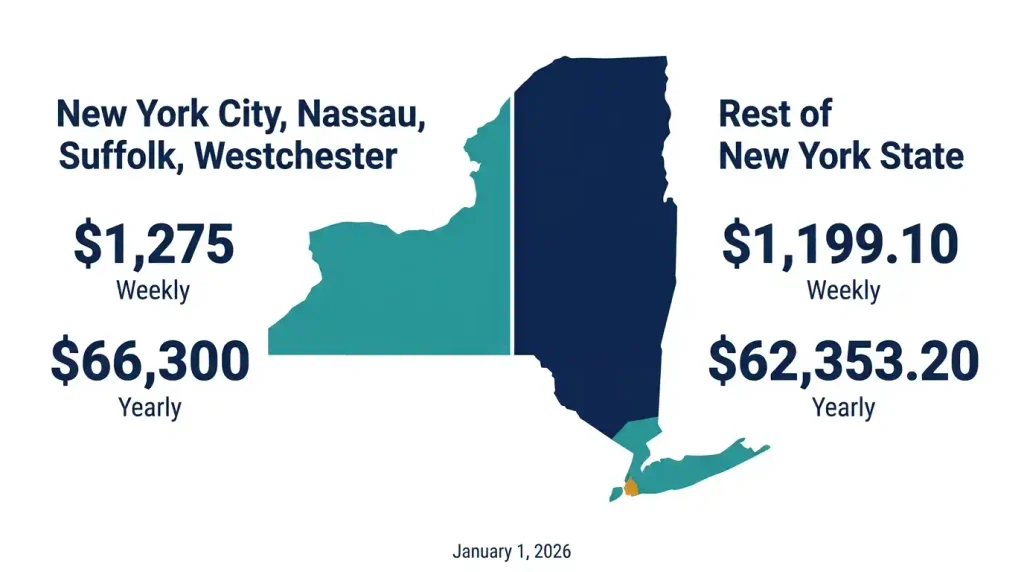
The higher $1,275 applies in New York City, Nassau County, Suffolk County, and Westchester County. Every other county uses $1,199.10. It applies to the executive and administrative exemptions only.
The floor follows the state minimum wage, which is $17 downstate and $16 in the rest of the state in 2026. The rules come from the New York Minimum Wage Act and each New York wage order, such as 12 NYCRR Part 142 for most industries. These New York wage and hour regulations set the exemption tests.
Does Meeting the Salary Threshold Make You Exempt?
No. Reaching the New York overtime exemption salary threshold is only half the test. You must also pass the duties test, which checks what you actually do. Pass the salary test but fail the duties test, and you still get overtime. Professionals follow a different rule, covered below.
Who Must Meet New York’s Overtime Salary Threshold?
Executive and administrative employees must clear the salary floor. Professionals follow a separate rule. Many salaried workers fit none of these groups and get overtime regardless of their offer letter.
Executive Employees
An executive runs a business or a real department as the main part of the job. You direct other workers and can hire and fire, or your recommendations carry real weight.
Administrative Employees
An administrative employee does office or non-manual work tied to running the business, like budgets, purchasing, HR policy, or planning. You use your own judgment on matters that count. Making or selling the product is production and sales work, not administrative work.
Professional Employees
A professional does work that needs advanced knowledge from long, specialized study, and uses judgment, not a checklist. Think lawyer, doctor, or engineer. New York sets no higher salary floor for professionals, but the federal minimum of $684 a week still applies.
Employees Who Are Not Exempt
A salary does not cancel overtime, as our guide to overtime for salaried employees in New York shows. A $55,000 office coordinator who follows set steps all day earns under both salary floors, so time and a half applies after 40 hours in a week. You cannot sign away overtime, so a contract that waives it carries no weight, per the NYSDOL overtime FAQ.
Under New York state overtime laws, overtime pays one and a half times the regular rate of pay, so a $20 hourly rate becomes $30. A few jobs exempt from federal overtime still get state overtime at one and a half times the state minimum wage.
New York Salary Test vs. Duties Test: How the Exemption Actually Works
Exempt status needs two things: enough pay and the right duties. Your employer needs both to skip overtime.
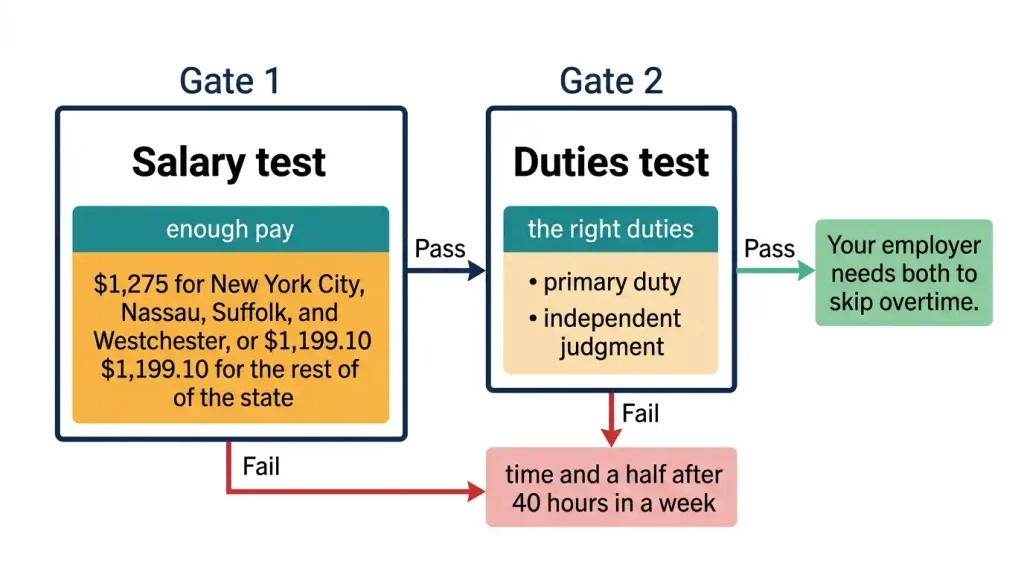
The Salary Basis Requirement
Paid on a salary basis means a fixed amount every pay period that does not shrink for a slow week. Improper deductions can break this rule. Salary basis is how you are paid. The salary amount is how much.
Extra hours do not change that. An exempt employee gets the same salary in a 38-hour week or a 55-hour week.
Do not confuse this with a second number. Since March 13, 2024, the threshold for exemption from New York pay frequency laws, direct-deposit consent, and other wage-payment rules is $1,300 a week for executive, administrative, and professional employees. It is not the overtime threshold.
The Duties Requirement
Your real work decides this, not your title. The state looks at your primary duty, the main thing you do, and whether you use independent judgment on important matters. A “manager” title with no power to hire, fire, or decide anything does not count.
Executive Exemption Duties
An exempt executive manages the business or a recognized department and directs at least two other employees. You can hire and fire, or your advice carries real weight, and you make decisions yourself.
Administrative Exemption Duties
Your work must tie directly to management or general business operations, like finance, policy, and planning, and involve discretion and independent judgment on matters of real weight. Someone who processes forms by the book fails. Someone who sets the rules for that process may pass.
New York Overtime Threshold vs. Federal FLSA Rules
Both rule sets apply, and the one that protects the worker more controls. For executive and administrative jobs, that is New York’s.
How New York and Federal Overtime Rules Interact
The Fair Labor Standards Act, or FLSA, is the federal law. New York labor law adds its own rules, set out in the New York Labor Law. Both apply at once.
Federal law also has a highly compensated employee exemption at $107,432 a year. New York’s wage order does not list a matching exemption, so high pay alone will not exempt a worker here.
What Happens When the Federal and New York Thresholds Differ?
The federal minimum is $684 a week ($35,568 a year). New York’s is roughly 1.75 to 1.9 times that for executive and administrative workers. Someone earning $50,000 in Albany clears the federal bar but sits under New York’s $62,353.20, so overtime applies past 40 hours.
Why Checking Only the Federal Threshold Can Be a Mistake
Payroll teams that quote only an old federal figure end up owing back pay. Check the New York number first, then the federal one, using official sources like the New York State Department of Labor and the U.S. Department of Labor.
The U.S. Department of Labor regulations spell out the federal duties tests, so read them next to the New York rules.
How to Calculate Whether a Salary Meets the 2026 Threshold
Convert pay to a weekly number, because the law is written weekly.
Calculate the Weekly Salary From an Annual Salary
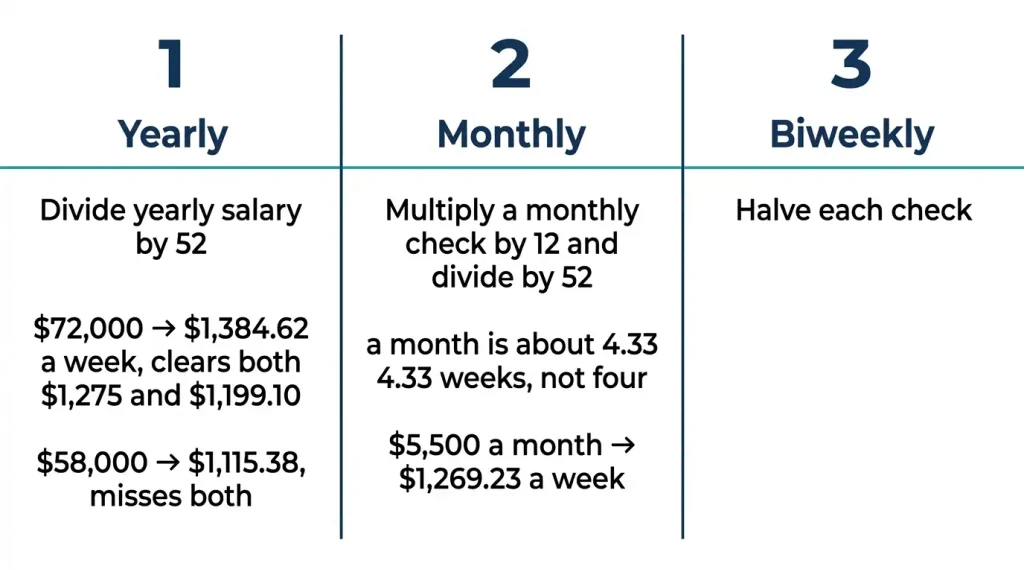
Divide yearly salary by 52. A $72,000 salary gives $1,384.62 a week, which clears both $1,275 and $1,199.10. A $58,000 salary gives $1,115.38, which misses both.
Monthly or biweekly pay is fine if the weekly equivalent meets the floor. Multiply a monthly check by 12 and divide by 52, since a month is about 4.33 weeks, not four. So $5,500 a month is $1,269.23 a week. For biweekly pay, halve each check. To turn pay into take-home pay, use our New York paycheck calculator and read our calculation methodology.
Calculate the Annual Salary From the Weekly Threshold
Multiply by 52. $1,275 gives $66,300, and $1,199.10 gives $62,353.20. The law uses the weekly figure.
What If the Salary Is Exactly at the Threshold?
Exactly $1,275 a week downstate meets the salary test and nothing more. You still need the duties test and a real salary basis. Watch rounding. $62,353 a year is about $1,199.096 a week, a hair under the $1,199.10 floor, so add the missing twenty cents a year.
What If the Salary Is Just Below the Threshold?
Close does not count. A New York City worker at $66,000 a year earns $1,269.23 a week, $5.77 short, so the executive and administrative exemptions fail. Raise the pay to the floor or treat the job as overtime-eligible.
Real-World 2026 Examples of Employees Near the Threshold
Four cases show how pay, place, and duties work together.
Example: $60,000 Salary Outside Downstate
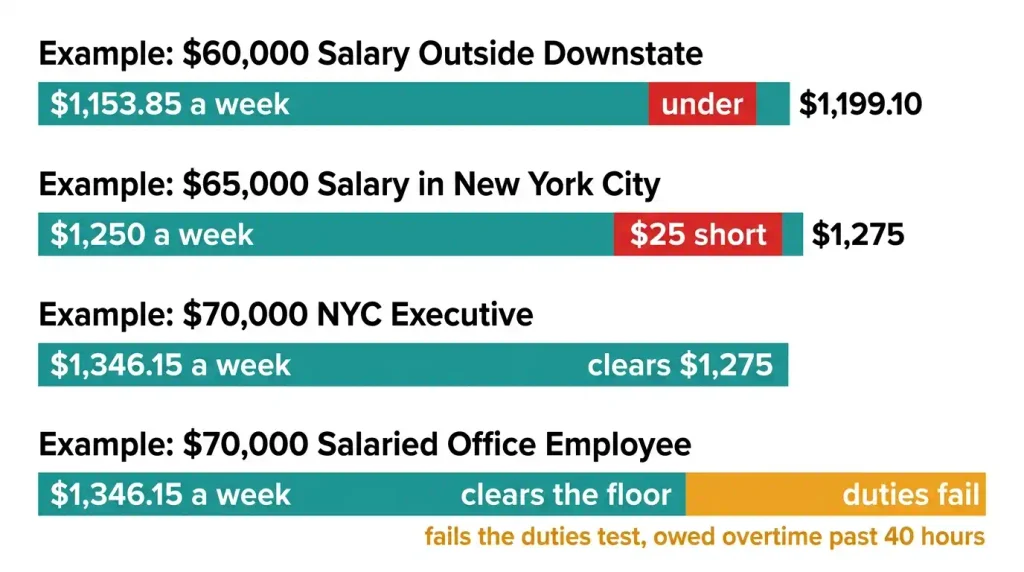
$60,000 is $1,153.85 a week, under the $1,199.10 rest-of-state floor. The salary test fails even in the cheaper part of the state, so duties do not matter.
Example: $65,000 Salary in New York City
$65,000 is exactly $1,250 a week, $25 short of the New York City floor of $1,275. The same pay would pass the salary test in Rochester. In the city, this person gets overtime.
Example: $70,000 NYC Executive
$70,000 is $1,346.15 a week, which clears $1,275. If she runs a Brooklyn store, supervises six people, and makes hiring calls, she is a properly exempt executive. Without that authority, pay alone would not save the classification.
Example: $70,000 Salaried Office Employee
He also earns $1,346.15 a week and clears the floor, but he enters data and follows set procedures. Without real judgment on important matters, he fails the duties test, so he is owed overtime past 40 hours.
Edge Cases That Can Change the Overtime Analysis
Bonuses, raises, role changes, and remote work can each change whether an employee stays exempt.
Bonuses, Commissions, and Other Compensation
Base salary is what you test. Bonuses and commissions are extra and may not count toward the floor. Do not rely on them. The salary test sits in 12 NYCRR 142-2.14, so check it and New York State Department of Labor guidance first.
Benefits such as health insurance or a retirement match are not salary, so they cannot fill a gap either. Whether it is a discretionary bonus or a nondiscretionary bonus, test the base pay first.
Salary Changes During the Year
A raise can move someone over the line, and a cut can drop them under it. If pay falls below the floor, the exemption can end from that point. Check every exempt employee whenever the floor changes, and review them each January.
Employees Who Change Job Duties
Classification follows the work, not the old job description. A lead promoted into a real manager with hiring power may now fit the executive exemption. An administrator moved to the production floor may not. Review the role when the job really changes.
Remote and Hybrid Employees
Your work location sets the threshold, not company headquarters. A remote employee in Syracuse may fall under a different threshold than a coworker in Manhattan. Use $1,275 per week if you work in one of the four downstate areas and $1,199.10 per week anywhere else. If your employer is in another state but you work from home in New York, start with your New York work site.
NYSDOL’s minimum wage guidance says pay follows where the work is done. For split regions, employers may pay the highest rate for all hours, or each region’s rate for the hours worked there. That covers minimum wage, so ask NYSDOL how it applies to the salary floor.
Common Mistakes About New York’s Overtime Salary Threshold
Four beliefs about salary, titles, federal rules, and annual pay lead to misclassification.
“If I Am Salaried, I Am Automatically Exempt”
Wrong. Salary is a way of being paid. Exemption is a legal status earned through pay and duties. A salaried receptionist earning $48,000 can still be owed overtime.
A 1099 label does not settle it either. If you work like an employee, you may still be owed overtime.
“My Job Title Says Manager, So I Am Exempt”
Titles are free. The law looks at what you do. A “shift manager” who cannot hire, fire, or direct two or more people usually fails the executive test. A store manager paid $60,000 in Buffalo fails the salary test before duties are even considered.
“The Federal Threshold Is the Only Threshold I Need”
New York’s rule is much higher. Using $684 a week here is a costly mistake. Start with the New York number.
“The Annual Salary Is All That Matters”
Pay alone is not the test. The law counts weekly pay, depends on location, and still needs the duties test. A $90,000 salary does not make anyone exempt on its own.
What Employers and Payroll Teams Should Check Before Treating an Employee as Exempt
Run four checks on every exempt employee, in order, and write down the results.
Verify the Employee’s Work Location
Find where the person really works, then pick the 2026 threshold: $1,275 for New York City, Nassau, Suffolk, and Westchester, or $1,199.10 for the rest of the state. Note staff who split time across regions and keep the answer in the personnel file. If it is unclear, ask the New York Department of Labor.
Verify the Salary
Convert annual pay to weekly, confirm a fixed salary rather than an hourly rate in disguise, and compare it with the correct threshold. Re-check after every raise, cut, or schedule change.
Update payroll settings too. A system still set to last year’s $1,237.50 a week downstate marks people exempt who now fall short. A $62,400 rest-of-state offer to a new hire clears the line by only $46.80 a year, so the duties must fit.
Verify the Duties
List what the person does most of the day, match it to the executive or administrative test, and look for real authority, judgment, and supervision.
Review Required Pay Documentation
New York requires pay-rate notices, and the pay rate notice for exempt employees is the LS59 form, where it applies. Check that payroll records and wage statements match each person’s classification, and update the paperwork when pay or duties change. Our New York payroll and employer compliance section covers related employer duties.
What Employees Should Check If They Think They Are Misclassified
You can check this yourself in an afternoon.
Review Your Salary and Work Location
Write down your weekly pay (divide yearly salary by 52 if needed) and where you actually work in New York. Compare both with the right 2026 number and note recent pay changes. Your pay stub and employment agreement show your pay rate and pay period, and our guide on how to read a New York pay stub helps.
Review What You Actually Do at Work
List your main tasks in a normal week. Do you manage people, hire or fire, or make big decisions on your own? If most of your day is routine, the duties test may not fit you.
Track Hours and Pay Records
Log your weekly hours, noting unpaid meal breaks under New York meal break laws, and save pay stubs, your offer letter, and any pay notices you signed. Compare logged hours with what you were paid. Clear records strengthen any later claim.
Where to Find New York Wage and Overtime Information
Start with the New York State Department of Labor and the U.S. Department of Labor. Both post wage rules and explain how to file a complaint. This guide is general information (see our disclaimer), so for advice on your own case, talk to an employment lawyer. For more guides, browse our New York overtime laws section.
Frequently Asked Questions About the New York Overtime Salary Threshold
This New York overtime exemption FAQ answers common questions from workers and payroll teams.
What is the New York overtime salary threshold in 2026?
For executive and administrative employees, it is $1,275 a week ($66,300 a year) in New York City, Nassau, Suffolk, and Westchester, and $1,199.10 a week ($62,353.20 a year) in the rest of the state. Both started on January 1, 2026.
Is $62,353.20 a qualifying exempt salary in New York?
Yes, outside the downstate area. It is the yearly version of $1,199.10 a week. Downstate it falls short of $66,300. Duties still count.
Is $66,300 a qualifying exempt salary in New York City?
Yes. It equals $1,275 a week, which meets the downstate floor. The duties test still applies, and a person doing routine work is still owed overtime.
Does a salaried employee automatically qualify for overtime exemption?
No. Exemption needs both the salary test and the duties test. Failing either means time and a half after 40 hours in a week.
Does New York use the same overtime salary threshold as the federal government?
No. The federal minimum is $684 a week, and New York’s is far higher for executive and administrative jobs. Both laws apply, and the stricter one usually controls.
Is there a salary requirement for professional employees in New York?
New York sets no higher salary floor for professionals. The federal $684 a week minimum still applies, and the job must need advanced knowledge and real judgment.
Can an employee earning below the threshold still be called exempt?
For executive and administrative jobs, no. Below the floor, the exemption fails regardless of title or duties. The professional exemption works differently.
What happens if an employer incorrectly classifies an employee as exempt?
The employer may owe unpaid overtime plus other penalties. Workers can file a wage claim with the state labor department. Time records and pay stubs matter, so track hours now.
2026 New York Overtime Salary Threshold Checklist
Five yes-or-no questions show whether an exemption holds up for any employee.
Five Questions to Verify Exempt Status
- Is the work location right?
- Does the weekly salary meet the threshold?
- Is the person paid on a true salary basis?
- Do the real duties fit the exemption?
- Do the pay records match the classification?
One “no” puts the exemption at risk.
What to Do After Checking the Threshold
Pick the exemption category and test the duties against it. Fix the classification right away if something fails, since moving a worker to overtime-eligible costs less than back wages. Follow current guidance from the state and U.S. labor departments.
Do not expect a jump on January 1, 2027. The state says the minimum wage stays at $17 and $16 then, and the salary floor follows the minimum wage. Governor Hochul has proposed raises to $17.60 downstate and $16.55 in the rest of the state starting March 1, 2027. That needs legislative approval and would likely move the floor if passed. Confirm with NYSDOL each January.
Key Takeaways on New York’s 2026 Overtime Salary Threshold
Two weekly pay floors and one duties rule decide exemption.
The Numbers to Remember
$1,275 a week for New York City, Nassau, Suffolk, and Westchester. $1,199.10 a week for the rest of the state. That is $66,300 and $62,353.20 a year, effective January 1, 2026.
The Rule to Remember
Salary is only half the test, duties must fit too, and New York and federal rules apply together. Nonexempt workers generally get overtime after 40 hours in a week.
Official New York Overtime and Exemption Resources
NYSDOL and the U.S. Department of Labor publish the current salary floors and exemption rules.
New York State Department of Labor
The NYSDOL minimum wage FAQ explains the salary threshold for executive and administrative employees. The main site, dol.ny.gov, covers exemption rules and wage and hour FAQs, and the NYSDOL overtime FAQ explains how overtime is calculated and why it cannot be waived.
U.S. Department of Labor
The Wage and Hour Division FLSA page covers federal overtime and exemption rules. The salary levels page lists the current federal figure, $684 a week.

Meet Yasin Ali, Founder
Yasin built NY Paycheck Calculator in 2020 after getting fed up with calculators that treated New York like every other state. Most tools ignore the extra local tax NYC and Yonkers workers pay on top of state tax — or skip New York’s Paid Family Leave deduction entirely.
He keeps the numbers current, checking in regularly against the latest IRS, NY Department of Taxation and Finance, and Paid Family Leave rates.
All results here are estimates based on official sources. For advice specific to your situation, talk to a tax professional.