
New York law sets a minimum pay frequency by job type: manual workers must be paid weekly, while office, sales, and other workers can legally be paid less often, though biweekly pay for physical labor requires special employer authorization.
That weekly-pay rule comes from New York Labor Law Section 191, which sets separate frequency floors for each worker category.
Exceptions are narrow, easy to misjudge, and whether workers can sue directly remains legally unsettled.
New York Pay Frequency Laws at a Glance
| Category | Biweekly Allowed? |
|---|---|
| Manual workers | Only with Commissioner of Labor authorization or nonprofit exception |
| Clerical and other workers | Yes, clears the floor automatically |
| Commission salespeople | Not applicable, paid monthly by default |
| Railroad workers | No |
How often must New York employers pay employees?
New York sorts workers into categories, each with its own minimum. Manual workers: weekly. Clerical and other workers: at least twice a month. Commission salespeople: at least once a month. Railroad workers: weekly, by Thursday. No one can legally be paid less often than their category allows.
| Worker Type | Minimum Pay Frequency |
|---|---|
| Manual worker | Weekly |
| Clerical or other worker | Semimonthly |
| Commission salesperson | Monthly |
| Railroad worker | Weekly, by Thursday |
Biweekly pay, the familiar 26-paychecks-a-year schedule, is not one of the four categories the law recognizes. It satisfies the semimonthly floor for clerical workers, but for manual workers it usually falls short without real authorization.
New York pay frequency requirements by worker type
Manual workers, anyone spending more than a quarter of their shift on physical tasks, get the strictest rule: weekly pay, period. Clerical and other workers, the desk and admin roles, only need twice-monthly paydays. Commission salespeople work on a monthly clock tied to when the commission was earned. Railroad workers follow their own older weekly schedule. Your job duties, not your title, decide which column applies. These rules apply the same way in New York City, Long Island, Westchester County, or anywhere upstate.
What changed for New York pay frequency laws in 2026?
The weekly rule for manual workers has not changed. The penalty structure has. A budget amendment Governor Hochul signed on May 9, 2025, as part of the 2025-2026 fiscal year budget, scaled back damages for first-time violations under Labor Law Section 198. An employer paying manual workers biweekly in good faith now generally faces interest on the late portion, not a full second payment. Repeat violations still risk damages up to 100 percent of the affected wages. Biweekly pay did not become legal by default. Only the penalty changed.
Weekly, Biweekly, Semimonthly, and Monthly Pay Compared
Weekly means 52 paychecks a year. Biweekly means 26. Semimonthly means 24. Monthly means 12. That fact explains most confusing payroll conversations with HR.
Weekly pay versus biweekly pay
Weekly pay gives you 52 paychecks a year on a fixed seven-day cycle. Biweekly gives you 26, on a fixed 14-day cycle, so two months a year bring three paychecks instead of two. For manual workers, weekly is the legal default; biweekly needs a specific exception or Commissioner authorization on file. Switching a crew from weekly to biweekly without that paperwork is not an administrative choice. It is breaking the law. If you are moving from weekly to biweekly yourself, budget for the wider 14-day gap and one longer stretch between your last weekly check and your first biweekly one.
Biweekly pay versus semimonthly pay
Biweekly and semimonthly both sound like twice a month, but they are not the same. Biweekly is 26 payments a year on a strict 14-day cycle. Semimonthly is 24 payments a year on fixed calendar dates, like the 15th and the last day of the month, so the gap between checks stretches and shrinks, sometimes 13 days, sometimes 19. Either schedule satisfies the semimonthly minimum for clerical workers, but manual workers cannot move to either one without authorization.
Monthly pay versus semimonthly pay
Monthly pay means 12 paychecks a year instead of 24. In New York, only commission salespeople can legally be paid monthly, based on commissions earned the prior month and paid by the last day of the following month. Clerical and other workers cannot drop to monthly pay; their floor stays semimonthly no matter what the offer letter says.
New York pay frequency comparison table
| Schedule | Paychecks Per Year | Typical Interval | Who Can Legally Use It |
|---|---|---|---|
| Weekly | 52 | 7 days | Manual workers, railroad workers |
| Biweekly | 26 | 14 days | Clerical workers; manual workers only with authorization |
| Semimonthly | 24 | 15-16 days, uneven | Clerical and other workers; authorized manual workers |
| Monthly | 12 | Calendar month | Commission salespeople only |
What Is New York’s Pay Frequency Law?
Payroll confusion in New York almost always starts in the same place: Section 191, part of New York Labor Law Article 6, cited in court filings as NY Labor Law § 191, enforced by the NYS Department of Labor (NYSDOL).
New York Labor Law Section 191 explained
Section 191 sets New York’s minimum payday rules. It lays out separate frequency requirements for manual workers, clerical and other workers, and commission salespeople, and requires employers to designate regular paydays in advance. Subsection 2 bars requiring an employee, as a condition of employment, to accept wages less often than the law allows, even with the employee’s consent.
Who is covered by New York’s payday laws?
Section 191 covers employees working in New York, full-time, part-time, temporary, or seasonal. It does not cover independent contractors, who are paid under private contract. Manual workers, clerical and other workers, commission salespeople, and railroad workers each get their own rule, so classification decides everything.
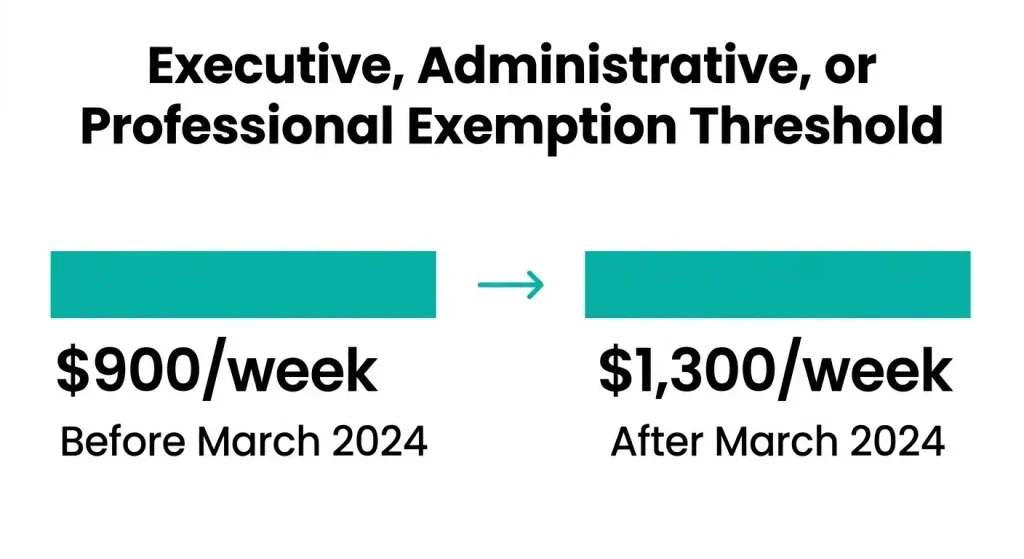
One exemption exists: employees in a bona fide executive, administrative, or professional capacity earning at least $1,300 a week are outside Section 191 entirely. That threshold rose from $900 to $1,300 in March 2024.
Company size never removes coverage; the only size-based rule is the 1,000-employee Commissioner authorization threshold. Federal, state, and local government employers sit outside Section 191 entirely. Coverage follows where the work is physically performed, not where the employer is based or where you live. Home health aides and other domestic workers doing physical care count as manual workers. Farm workers are covered too, and New York Labor Standards has them file wage complaints on a separate form, the LS710, instead of LS223.
Pay frequency versus payday and pay period
These terms get confused constantly. Pay frequency is how often you are paid. A pay period is the block of time your wages cover. Payday is the specific date the money lands. A paystub lists the pay period separately from the payment date, and the gap between the two is what Section 191 regulates.
How Often Must Employers Pay Different Types of Workers?
Your job duties, not your title, decide your legal payday floor.
Manual workers must generally be paid weekly
Spend more than 25 percent of your hours on physical tasks and you are a manual worker, owed weekly pay within seven calendar days after the workweek ends. The pay period is the seven days worked; the payday is the deadline to pay for it. Common manual roles: warehouse associates, construction laborers, landscapers, line cooks, retail stockers, though actual duties decide, not the job title. Many of these same shifts also trigger New York’s meal break rules, so it is worth checking both protections together.
Clerical and other workers must be paid at least twice monthly
Clerical and other workers, the catch-all for office, admin, and anyone outside manual, commission, or railroad work, must be paid on regular paydays designated in advance, at least semimonthly. That is not automatically biweekly; biweekly just happens to clear the semimonthly floor.
Commission salespeople have separate payment rules
Commission salespeople, sometimes called commissioned salespeople in the statute, must be paid under their agreed terms, but at least once a month, by the last day of the month following the one the commission was earned. Written commission agreements define what counts as earned. Employees can request a written statement showing how earnings were calculated.
Railroad workers have a separate statutory payday
Railroad workers follow an older, specific rule: wages paid on or before Thursday, covering the seven-day period ending the previous Tuesday. This applies to covered railroad laborers, not other transportation workers like truck drivers or transit employees.
When Is Biweekly Pay Legal in New York?
The ordinary rule for manual workers
Weekly pay is the default for manual workers, and long-standing payroll habits do not change that. Ten years of biweekly payroll without getting caught is still a violation every pay period. A contract cannot fix it either; Section 191 bars requiring employees to accept less frequent pay. Biweekly pay for manual labor is a real compliance problem unless the employer has documented Commissioner of Labor authorization on file.
When the Commissioner of Labor can authorize less frequent pay
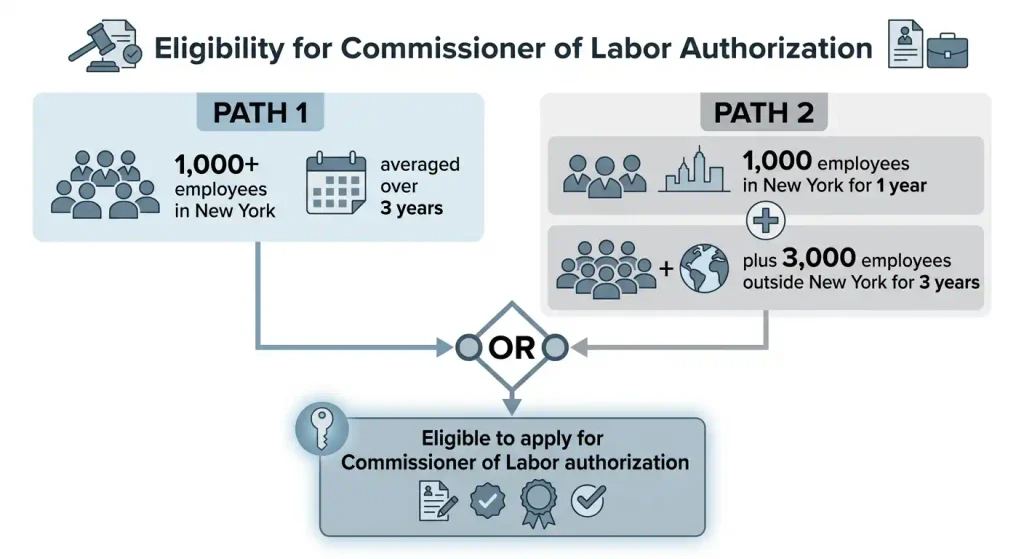
Large employers of manual workers can apply to the Commissioner of Labor for permission to pay semimonthly instead of weekly. Qualifying generally requires an average of 1,000 or more employees in New York over three years, or 1,000 in New York for one year plus 3,000 outside the state for three years, along with a track record of financial stability. It is not a rubber stamp; the employer must prove reliability, and even authorized employers cannot drop below semimonthly.
Nonprofit organizations and manual worker pay
Manual workers at qualifying nonprofits follow a different rule: agreed terms of employment instead of the strict weekly requirement, as long as those terms meet the semimonthly minimum. This exception is separate from Commissioner authorization and exists because nonprofit payroll often runs leaner.
How to check an employer’s biweekly authorization
The New York State Department of Labor keeps a public list of employers authorized to pay manual workers less frequently than weekly, historically only a couple hundred statewide, so check the current list rather than assume.
- Search the list by the employer’s exact legal name
- Employers apply through MPWR, the state’s online Management System for Protecting Workers’ Rights, which requires an NY.gov ID
- Appearing on the list only confirms that one exception; it does not clear every other payday rule or cover every manual worker automatically
- A collective bargaining agreement alone does not create the exception either; union assent can support an application, but the Commissioner still has to approve it
- If an employer claims permission but cannot produce matching documentation, treat the schedule as unauthorized
- If your employer is not on the list, biweekly pay for manual labor is very likely unauthorized, and the Division of Labor Standards is a reasonable next step
For broader New York payroll compliance rules employers need to follow, that category covers related requirements beyond pay frequency alone.
What documents employers may need for authorization
To get authorized, employers typically submit recent computerized payroll records, employee wage transcripts, and NYS-45 filings that match. A notarized affidavit on payroll reliability and proof of adequate insurance are usually required. Union support documentation helps for organized workforces, though it is not required for every applicant.
How to Determine Which Pay Frequency Rule Applies to Your Job
Your job duties decide your New York worker classification, which in turn decides your legal payday floor.
How New York defines a manual worker
New York defines a manual worker broadly: mechanics, laborers, anyone doing physical work, with no fixed official job title list. What matters is spending more than 25 percent of your time on tasks like lifting, standing, cleaning, or operating equipment. A title like “associate” or “technician” proves nothing on its own.
| If more than 25% of your day is… | You are classified as… | Legal pay floor |
|---|---|---|
| Lifting, standing, cleaning, operating equipment | Manual worker | Weekly |
| Desk work, phones, admin, office tasks | Clerical or other worker | Semimonthly |
How clerical and other workers are classified
Clerical and other workers cover office and administrative duties, plus anyone outside the manual, commission, or railroad categories. Classification follows actual job function, not the payroll label. A receptionist answering phones and filing paperwork is clearly clerical no matter what a title says.
What if your job combines manual and clerical duties?
Mixed jobs, like a retail employee splitting time between stocking and the register, get classified by the actual proportion of physical labor, using that 25 percent threshold as the line. Time records and shift logs clear up ambiguity; when it is genuinely unclear, ask the Department of Labor instead of guessing.
Does being salaried or exempt change payday frequency?
Salary status and pay frequency are separate legal questions. Being salaried does not remove you from the manual worker category, and overtime exemption has nothing to do with Section 191’s frequency rule. A salaried warehouse supervisor still working the floor remains a manual worker owed weekly pay.
New York Payday Deadlines and Payroll Schedule Changes
How the seven-day manual worker deadline works
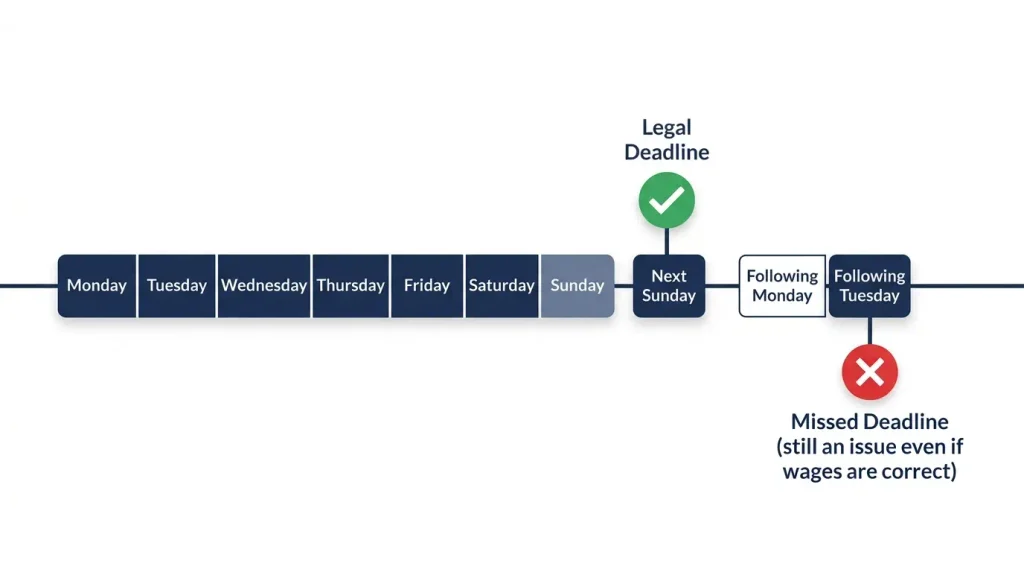
The seven-calendar-day clock starts when the workweek ends, not when the check is cut. A Monday-through-Sunday workweek must be paid by the following Sunday. Paying the next Tuesday instead already misses the deadline, even with accurate wages.
How regular paydays must be established
Employers must set regular paydays in advance and communicate them, typically at hiring through New York’s written notice of pay rate and payday, most often Form LS52, kept on file, signed by both sides, for six years. Employers can pick any specific weekday or date that still meets the deadline for your worker category. Check your onboarding paperwork or handbook to confirm your official payday.
Can an employer change the payday or payroll frequency?
An employer can change payroll schedules, but the new one still has to meet the statutory minimum. New York’s statute sets no exact number of days for advance notice, only that the new payday be designated and communicated before it takes effect. Weekly to biweekly is not an “ordinary” change for manual workers without a real exception or authorization behind it.
What happens when payday falls on a weekend or holiday?
Employers often shift the payment date around a weekend or bank holiday, and that alone is not a violation. What matters is whether the adjusted date still falls within the statutory deadline, like the seven-day window for manual workers. Track the scheduled payday against the actual one to spot a real problem.
What if payroll processing causes a delay?
A payroll glitch or direct deposit hiccup does not excuse a late payment. The actual date wages hit your account is what counts. Recurring delays start looking like a frequency problem, and an employer cannot dock your pay to cover the cost of fixing its own mistake.
Real-World New York Pay Frequency Scenarios
An hourly warehouse worker receives biweekly pay
An hourly picker moving boxes all shift is doing manual work, owed weekly pay. Biweekly pay means checking the NYSDOL authorization list under the employer’s exact legal name. No listed exception means a real compliance problem.
An office employee receives two paychecks each month
Paid on the 15th and the last day of the month at the front desk, you are almost certainly clerical, and that schedule clears the minimum. Just confirm those paydays were actually designated in advance.
A salaried employee is paid monthly
A salaried marketing coordinator paid monthly sounds normal, but salary status does not decide legality. Clerical duties mean monthly pay falls short of the semimonthly floor, and a signed offer letter cannot override that minimum.
A commission salesperson receives monthly payments
A car salesperson paid monthly, by the last day of the following month, is on track with the statute. Confirm written commission terms exist and match what is paid; request a written earnings statement if the math looks off.
A manual worker’s employer announces a move to biweekly pay
A memo switching a warehouse from weekly to biweekly is an announcement, not permission. Check the NYSDOL authorization list and whether the employer qualifies as a nonprofit exception. Keep a written record of both schedules and the announcement date.
A worker receives the right wages but on the wrong schedule
Full payment, just late, is still a frequency violation on its own. The damages landscape shifted with the 2025 budget amendment, so check current NYSDOL guidance before assuming a specific remedy.
New York Pay Frequency Laws and Related Employment Rules
How final paycheck laws interact with pay frequency
Final wages are due no later than the regular payday for the period covering termination; the schedule does not accelerate or delay for quitting or getting fired. Employees can request final wages be mailed.
How overtime pay fits into the payday schedule
Overtime entitlement and payment frequency are separate issues that meet on the same check. Nonexempt employees working over 40 hours a week are generally owed time and a half under New York’s overtime laws, paid on the regular schedule. The frequency does not remove the obligation to pay overtime correctly.
How pay frequency differs from minimum wage and wage deductions
Correct hourly pay under New York’s minimum wage says nothing about correct timing; these are separate compliance questions. Wage deductions, like uniform or equipment costs, run under their own statute, covered in detail in New York paycheck deduction rules. One paystub can have the right rate, wrong deduction, and wrong frequency at once, so check each issue on its own.
Employee versus independent contractor payment rules
Section 191 protects employees, not independent contractors, who follow their contract’s payment terms. Understanding where that line sits starts with New York’s employee vs independent contractor rules. Freelancers doing qualifying work anywhere in New York State get separate protection under the New York Freelance Isn’t Free Act, statewide since 2024, covering hiring parties engaging a freelancer for $800 or more, requiring a written contract and payment within 30 days of completing the work if no earlier date was set. Your actual classification decides which rules protect you.
Federal and state payday requirements
The federal Fair Labor Standards Act (FLSA) sets minimum wage and overtime rules but mandates no specific payday schedule nationwide. New York’s Section 191 is unusually specific, giving New York employees enforceable payday protections many other states lack. Unpaid overtime or minimum wage issues fall under federal authorities too.
Common Myths About New York Pay Frequency Laws
Myth: Every New York employee must be paid weekly
Only half true. Manual workers get weekly pay; clerical and other workers get semimonthly; commission salespeople get monthly; railroad workers get their own Thursday deadline. “Weekly for everyone” is not how the statute reads.
Myth: Every employer can choose biweekly pay
Biweekly feels standard, but for manual workers it is only legal with real Commissioner authorization or a qualifying nonprofit exception. A long-standing company policy is not a legal exception.
Myth: Salaried employees can always be paid monthly
Salary status has nothing to do with worker category. Clerical and other workers keep a semimonthly floor regardless. Only commission salespeople get a monthly minimum, based on how commissions are earned.
Myth: A signed contract overrides the payday law
Section 191 bars requiring employees to accept less frequent pay as a condition of employment, so a signature cannot waive it. Agreed terms can set details like exact payday dates, but not drop below the minimum frequency.
Myth: Receiving the full paycheck means there was no violation
Full payment and correct timing are different questions. Getting every dollar seven days late is still a frequency violation on its own, whatever remedy it carries.
Myth: Payroll software problems excuse every late paycheck
A payroll glitch does not excuse a late payment legally. The actual date money hits your account is what the law measures, and recurring “technical issues” stop looking technical.
What Happens If Your Employer Violates New York Pay Frequency Laws?
How to recognize a potential payday violation
Confirm your worker classification and compare it to the legal minimum frequency. Check your designated payday against the dates you were actually paid. Verify whether any exception or Commissioner authorization applies before assuming a violation; an isolated delay reads differently than a recurring problem.
What to do before filing a wage complaint
Before filing, gather:
- Paystubs, your written schedule, or offer letter
- Time records and any payroll notices about schedule changes
- The dates wages were earned, logged against the dates received, since that comparison is the core of a frequency complaint
- Any employer explanation or claimed authorization, noted separately from missing wage amounts
You do not need to raise it with your employer first.
How to file a complaint with the New York State Department of Labor
The Division of Labor Standards, enforcing New York State Labor Standards, handles these cases; frequency violations use the LS223 wage complaint form. You will need the employer’s legal name and address, pay records, and the schedule you believe applies. Check the NYSDOL website for current contact and submission details. Resolution time varies with claim complexity and caseload; NYSDOL sets no fixed number of days.
What remedies and penalties may apply?
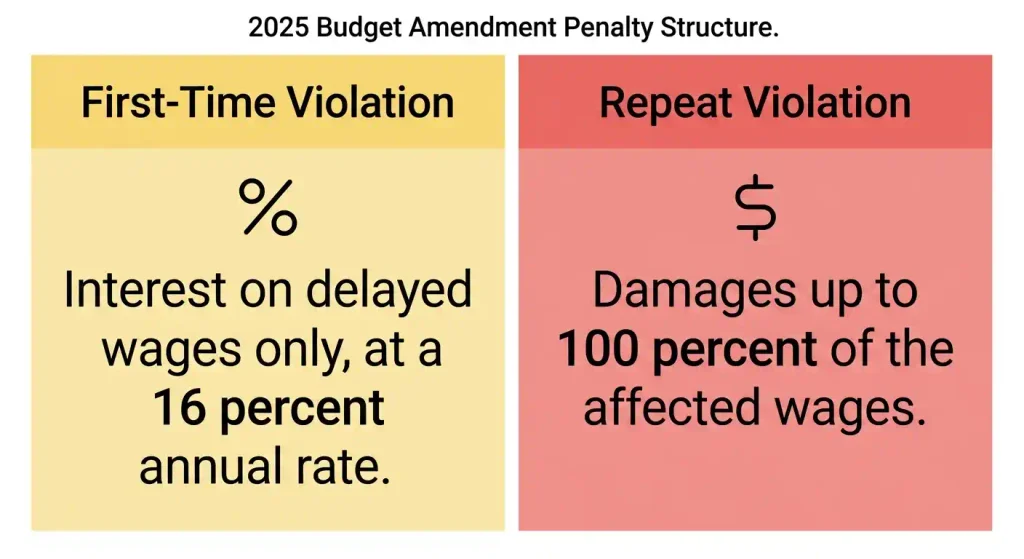
An administrative complaint differs from a private lawsuit. Missing wages are generally recoverable either way. Frequency-only damages became more limited under the 2025 budget amendment for first-time offenses, capped at interest on delayed wages using the Department of Financial Services daily rate under Banking Law Article 14-a, currently 16 percent annually, instead of a full second payment. Repeat violations can still mean damages up to 100 percent of the affected wages. Whether manual workers even have a private right of action to sue under Section 191 remains unsettled; New York’s appellate courts are split, and the question has not yet been resolved by the New York Court of Appeals.
Can an employer retaliate against an employee for complaining?
Retaliation for raising a wage complaint, internal or to the state, is prohibited. It can look like a sudden schedule cut, an unexplained write-up, or a demotion right after a complaint. Document the timeline and anything that changed at work. New York Attorney General workers’ rights complaints are a separate track for broader patterns, through that office’s Labor Bureau.
What if the employee has already left the job?
Final wages stay due by the regular payday covering the termination date, even after you are gone. Keep payroll records, your final schedule, and any communication with your former employer. Leaving a job does not erase a wage claim.
How to Check Your Pay Schedule and Take Your Next Step
A quick checklist for verifying your employer’s schedule
- Confirm your job duties and statutory category
- Compare your pay frequency to the legal minimum
- Check your designated payday against actual payment dates
- Verify any claimed exception or authorization before assuming a violation
- Evaluating a new offer with biweekly or monthly pay for a physical job? Ask about Commissioner of Labor authorization before accepting, and expect your first paycheck to land later than usual
- Run your numbers through a New York paycheck calculator to confirm your take-home pay lines up with what your schedule should deliver
Documents to review and keep
- Recent paystubs and your offer letter or employment terms
- Payroll announcements or schedule-change notices
- A dated log of time worked and payments received
- Any correspondence mentioning authorization or exceptions
Where to get official New York payday guidance
The New York Department of Labor Frequency of Pay page is the current official source, along with the statutory text of Section 191 and the department’s New York State wage payment FAQs. The wage complaint form and Division of Labor Standards contact information are posted there too. For more New York payroll and paycheck guides, browse the full blog archive.
What to do if the rules are unclear
If your classification, schedule, or a claimed authorization still does not add up, contact NYSDOL directly. This article points you in the right direction but is not legal advice; for a real dispute, talk to a qualified employment lawyer.
Frequently Asked Questions About New York Pay Frequency Laws
Is biweekly pay legal in New York in 2026?
For clerical and other workers, yes, since it clears the semimonthly floor. For manual workers, only with Commissioner authorization or a qualifying nonprofit exception.
Can an employer pay manual workers twice a month?
Only with Commissioner of Labor authorization or the nonprofit exception. Otherwise, weekly pay stays the default.
How many days can an employer go between paychecks?
Manual workers: no more than seven calendar days past the workweek’s end. Clerical and other workers: a semimonthly floor, roughly twice a month.
Can an employer change from weekly to biweekly pay?
Only with a real exception or authorization on file, and advance notice through a properly designated payday.
Do New York employers have to pay employees on a specific day?
Yes, regular paydays must be designated in advance. Manual workers also get the strict seven-day deadline.
Can my employer pay me monthly if I am salaried?
Only if you are a commission salesperson under the statute. Clerical and other workers keep a semimonthly minimum regardless of salary.
What can I do if my employer pays me late?
Document the scheduled payday against the actual one, check any authorization claim, and file a wage complaint with NYSDOL using the LS223 form.
Can I report my employer for paying me biweekly instead of weekly?
Yes, if you are a manual worker with no authorization or exception. Check the NYSDOL authorization list, then file a complaint with pay records.
Can I be fired for asking about payday laws?
Asking a question is not a protected complaint, but retaliation for either is prohibited. Document it and report retaliation to NYSDOL or a lawyer.
What is the deadline for filing a New York wage complaint?
Administrative complaints and private lawsuits follow different timelines. Check current official filing instructions for your specific deadline.
New York Pay Frequency Laws: Key Takeaways
The main payday rules to remember
Manual workers: weekly by default. Clerical and other workers: semimonthly floor. Commission salespeople: monthly minimum. Exceptions and Commissioner authorizations can shift these, but only when documented and verified.
The next steps if your payday schedule seems wrong
Confirm your real job classification first. Compare your designated payday to when you are actually paid. Check for a genuine exception or authorization before assuming a violation. When it still does not add up, official NYSDOL guidance settles it.

Meet Yasin Ali, Founder
Yasin built NY Paycheck Calculator in 2020 after getting fed up with calculators that treated New York like every other state. Most tools ignore the extra local tax NYC and Yonkers workers pay on top of state tax — or skip New York’s Paid Family Leave deduction entirely.
He keeps the numbers current, checking in regularly against the latest IRS, NY Department of Taxation and Finance, and Paid Family Leave rates.
All results here are estimates based on official sources. For advice specific to your situation, talk to a tax professional.