
The New York Wage Theft Prevention Act requires private employers to give workers a written pay rate notice at hiring and a wage statement with every paycheck, with civil penalties attached whenever either document goes missing.
Those penalties are real. New York sets separate dollar caps for missing notices and missing paystubs, sharpened by 2023 and 2025 amendments.
Knowing the rules doesn’t guarantee compliance, so workers still need to check their own paperwork.
What Is the New York Wage Theft Prevention Act?
Formally the New York State Wage Theft Prevention Act, the WTPA was passed after workers kept losing wages with no paper trail to prove what they were owed. It does not set new minimum wage or overtime rates, it just makes those existing rights provable and collectible through required records.
What the WTPA Protects Employees Against
The WTPA covers two separate problems: missing paperwork (no pay notice or paystub) and missing money (wages never paid). You can win a paperwork claim even if every dollar owed eventually arrived, since notice and statement duties stand on their own. It works alongside the rest of the Labor Law, including minimum wage, overtime, and tip rules, as the documentation that makes those rights enforceable.
When the Wage Theft Prevention Act Took Effect
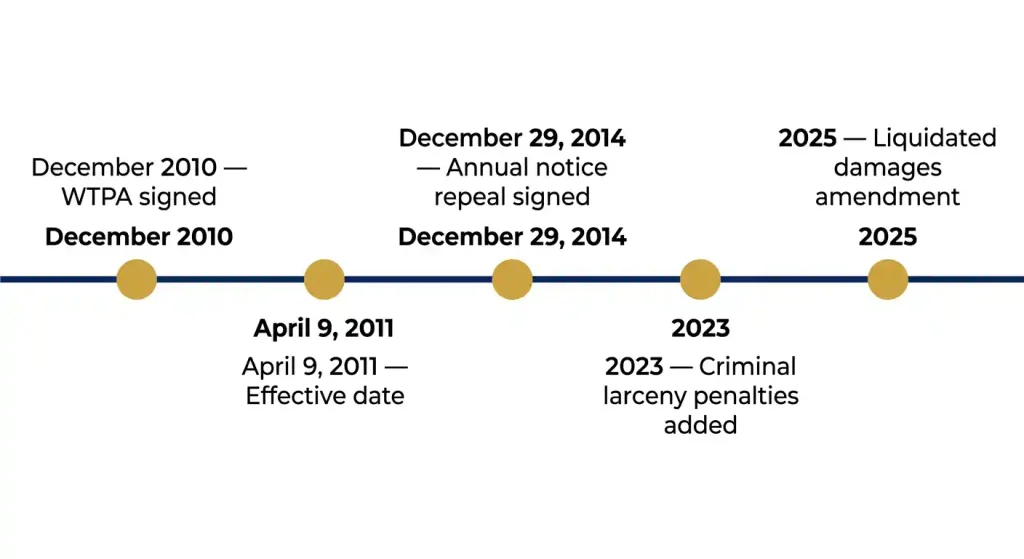
Governor David Paterson signed the WTPA in December 2010, effective April 9, 2011. New York later repealed the general annual notice requirement when Governor Cuomo signed an amendment on December 29, 2014, effective immediately for the 2015 notice cycle onward, and added criminal larceny penalties in 2023. The current 2026 version is what applies today.
Which New York Employers and Employees Are Covered?
Nearly every private-sector employer must comply: small businesses, nonprofits, private schools, charter schools, and staffing agencies. Full-time, part-time, temporary, seasonal, and probationary employees are covered equally, and exempt and nonexempt workers get identical notice and paystub protections even though overtime rights differ. Hourly, salaried, tipped, and commission workers are all covered. Federal, state, and local government employers are generally excluded. Remote employees working for a New York employer are still protected, but work entirely outside the state is not.
What Must Employers Tell Employees About Their Pay?
Before your first hour of work, your employer must give a written notice of pay rate, pay frequency, and overtime rate, signed by you to confirm receipt. Our full breakdown of New York wage notice requirements covers sample language employers can use.
Written Notice of Pay Rate at Hiring
This notice is due at hiring, not later and not after a bad paycheck. It applies to hourly, salary, shift, day, commission, or piece-rate pay. It is a standalone pay notice, not a full employment contract. New York does not require a separate written employment agreement, but this specific notice is required regardless of what else you signed.
What Information Must a New York Pay Notice Include?
A compliant notice lists your rate of pay, how it is calculated, your overtime rate if applicable, and your regular payday, under New York Labor Law Section 195.1. It must also include your employer’s legal name, any DBA, business address, and phone number. Tip, meal, lodging, home care aide, or prevailing wage details must appear if they apply. For manual labor, New York Labor Law Section 191 generally requires weekly pay rather than biweekly or monthly, a rule covered in more depth in our guide to New York pay frequency laws.
Pay Notice Language and Employee Acknowledgment
The notice must be in English, plus your primary language if the New York State Department of Labor (NYSDOL) has a translated template. You sign and date it, your employer keeps a copy, and you are entitled to one too. Without an official translation, English alone satisfies the requirement.
Official NYSDOL Pay Notice Forms
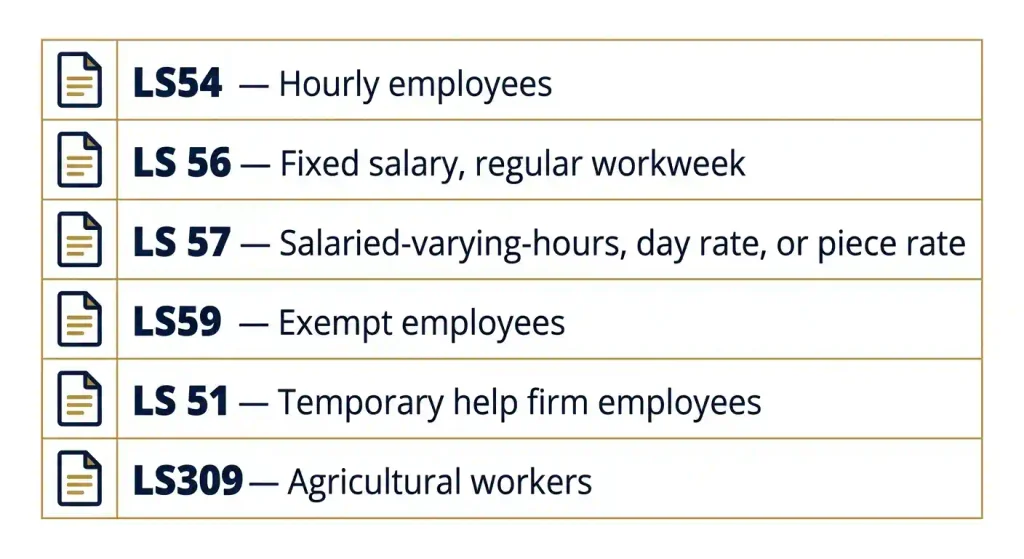
NYSDOL’s sample forms, officially the Notice and Acknowledgement of Pay Rate and Payday, vary by pay type. Employers can use their own form instead, as long as every required field is included.
| Form | Who It’s For |
|---|---|
| Notice of Pay Rate Form LS54 | Hourly employees |
| LS 56 | Fixed salary, regular workweek |
| LS 57 | Salaried-varying-hours, day rate, or piece rate |
| Notice of Pay Rate Form LS59 | Exempt employees |
| LS 51 | Temporary help firm employees |
| Farm Worker Pay Notice Form LS309 | Agricultural workers |
New York Paystub Requirements: What Must Appear on Every Paycheck?
Every payday, your employer owes you a wage statement showing exactly how your pay was calculated, not just a deposit with no explanation. See our guide to New York wage statement requirements for a line-by-line checklist.
Required Information on a New York Wage Statement
Your paystub needs your name, your employer’s name, address, and phone number, the pay period dates, how pay is calculated, gross wages, deductions, minimum wage allowances, and net pay, all under New York Labor Law Section 195.3. Home care aide benefits or prevailing wage supplements must be itemized too.
Regular Hours, Overtime Hours, and Pay Rates
Nonexempt paystubs must break out regular and overtime hours separately, with the rate for each, plus multiple hourly rates or piece-rate pay if applicable. Check this first, since it is the easiest place to catch a missing overtime hour or math error.
Electronic Paystubs and Paper Wage Statements
Electronic paystubs are allowed with real, convenient access, including free computer and printer access at work if you need it. Getting a statement is not the same as getting paid. A perfect paystub attached to a bounced check is still a violation. If a paystub never arrives or you cannot access it, request it from your employer or raise it with NYSDOL.
Can Employees Request a Written Wage Calculation?
Yes. You can ask your employer, in writing, how your gross and net pay were calculated for any pay period, useful when deductions or totals look wrong. Verifying it needs your rate, hours, overtime, and every deduction. An unexplained answer puts the issue on record before you escalate.
Can an Employer Change Your Pay Rate Without Notice?
No. Your employer must tell you in writing at least seven calendar days before a pay rate reduction, unless the change already appears on your next wage statement.
The Seven-Calendar-Day Written Notice Rule
New York Labor Law Section 195 requires advance written notice before changes to your hourly rate, salary, commission, bonus structure, payment method, or other required pay information.
Pay Rate Reductions and Unexpected Paycheck Changes
A pay cut applies only to hours worked after notice, never retroactively to work already done. A retroactive cut is a bigger problem than a late notice. Compare any mismatched paycheck against your original and any change notices.
Special Pay-Change Rules for Hospitality Employees
Restaurant and hospitality pay adds tip credit and cash wage complexity. Changes to tip credit, cash wage, or multiple pay rates still require the same notice. Compare your tip credit notice, cash wage, and hours against your paystub to catch errors. Our guide to New York’s tipped minimum wage explains how tip credit and cash wage combine.
Does New York Require an Annual Wage Notice in 2026?
No. The general annual wage notice every January was repealed back in 2015, so no fresh notice is owed just because the calendar changed.
Why the General Annual Notice Requirement Was Repealed
Governor Cuomo signed the repeal on December 29, 2014, effective immediately, ending the annual notice starting with the 2015 cycle. Business groups called it redundant paperwork beyond what new-hire notices already covered. Employers still owe a notice at hiring and whenever required pay information changes.
What Employers Must Still Provide Every Payday
The paystub requirement never went away. You still get a wage statement every payday, no exceptions. The repeal removed one repetitive form, not the ongoing paystub duty.
New York Employer Payroll Recordkeeping Requirements
Your employer must keep payroll records for six years, and that paper trail often decides a wage claim.
The Six-Year Payroll Record Retention Rule
That six-year window covers payroll records, signed pay notices, acknowledgments, and wage documentation, proof of what you were paid and told if a dispute arises later.
Employee Timekeeping and Wage Documentation
Required records include weekly hours, regular and overtime rates, gross wages, and deductions, plus tip credit, meal or lodging allowances, piece-rate work, and paid sick leave usage.
What Happens When Employer Payroll Records Are Incomplete?
Missing or sloppy records make your pay harder to verify, and that usually works against the employer. NYSDOL and courts tend to favor workers when an employer cannot produce clean records. If an employer finds its own records show wrong hours or pay, it must fix the underlying pay, not just the paperwork. Incomplete recordkeeping alone can trigger enforcement.
What Are the Penalties for Violating the Wage Theft Prevention Act?
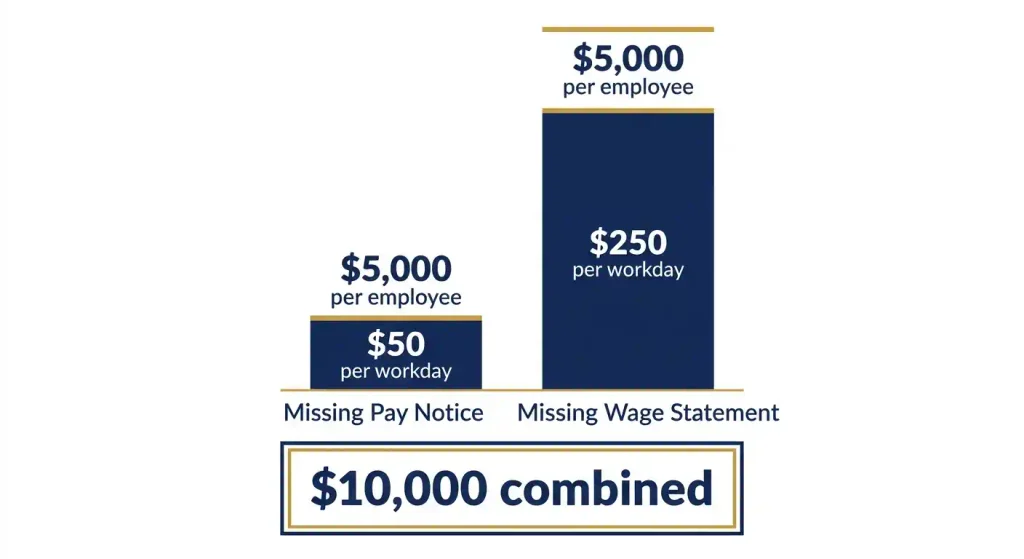
Your employer can owe statutory damages just for missing notices or paystubs, on top of any unpaid wages. Quick reference below, full conditions in each section after.
| Violation | Statutory Damages | Cap |
|---|---|---|
| Missing written pay notice at hiring | Up to $50 per workday | $5,000 per employee |
| Missing or incorrect wage statement | Up to $250 per workday | $5,000 per employee |
Penalties for Missing Written Pay Notices
A missing hiring notice can mean statutory damages up to $50 per workday, capped at $5,000 per employee in a covered civil claim, subject to statutory conditions and employer defenses.
Penalties for Missing or Incorrect Wage Statements
Missing or inaccurate paystubs carry up to $250 per workday, also capped at $5,000 per employee, a separate violation from being underpaid.
Additional Financial Consequences for Unpaid Wages
Beyond statutory penalties, you can recover unpaid wages, unpaid overtime, liquidated damages equal to the amount owed in many cases, interest, attorney fees, and litigation costs, under New York Labor Law Section 198. A 2025 amendment scaled back automatic liquidated damages for manual workers paid in full but late rather than weekly, unless the employer is a repeat violator. Unpaid commissions, bonuses, and wage supplements count as unpaid wages too.
Additional Civil and Criminal Consequences
Repeat violators face added civil penalties. Since the 2023 Wage Theft Accountability Act, willful wage theft can be prosecuted as criminal larceny under Penal Law Section 155.05(2)(f). Individual owners, officers, and managers directly involved can be held personally liable. Local district attorneys and the New York State Attorney General can also pursue cases. NYSDOL can pursue liens, levies, and warrants against business assets.
How Much Money Can an Employee Recover?
Recovery depends on whether you are claiming missing paperwork, missing wages, or both, and those add up differently.
Statutory Damages vs. Unpaid Wage Recovery
Notice and paystub statutory damages are capped separately at $5,000 each, up to $10,000 combined. Those caps apply per employee, so total employer exposure multiplies across a workforce. Actual unpaid wages are calculated separately based on what you were owed. The $5,000 figure is a cap, not a guarantee.
Practical Wage Theft Recovery Examples
No written notice at all: up to $50 per day, capped at $5,000. A notice but no paystubs for months: $250 per day, also capped at $5,000. Add unpaid overtime and incomplete payroll records, and statutory damages, unpaid overtime, and liquidated damages can stack together.
What Can Affect the Amount an Employee Recovers?
Employer defenses include proof all wages were paid on time, or that a violation was an isolated clerical mistake rather than willful. Strong evidence of hours and wages makes a claim easier to prove. Leaving or being fired does not erase a claim. If the business closes or goes bankrupt, collecting is harder, though liens and claims can still reach remaining assets. Limitation periods and legal costs also shape what you recover. A New York paycheck calculator can help you check what your take-home pay should have been in the first place.
Real-World New York Wage Theft Scenarios
A Restaurant Worker Receives Less Than the Promised Hourly Rate
A server’s paystub shows a lower cash wage than promised, with overtime paid at straight time. Comparing the original pay notice to the paystub reveals the missing tip credit allowance and uncalculated overtime, supporting a recovery claim.
A Retail Employee Discovers Unexplained Paycheck Deductions
An unauthorized “misc” deduction violates New York Labor Law Section 193. Requesting a written wage calculation shifts the burden to the employer to explain it, with bank statements or paystubs as evidence. For a full list of what employers can and cannot withhold, see our guide to illegal paycheck deductions in New York.
A Salaried Employee Works Overtime Without Additional Pay
Salary alone does not mean exempt from overtime. Exemption depends on actual job duties and salary-basis tests, verified against time records showing hours past 40. See our guide on overtime for salaried employees in New York for how those tests work.
An Employee’s Pay Rate Is Reduced Without Proper Notice
A rate drop with no warning should be checked against whether written notice arrived at least seven days ahead, per Section 195. A retroactive cut is a wage claim, not just a notice violation.
An Employee Is Fired After Reporting Unpaid Wages
Termination soon after a wage complaint raises a Section 215 retaliation issue, evaluated separately from the underlying wage claim. Preserve the timeline and any written complaints.
Common Wage Theft Prevention Act Myths and Misconceptions
Every Employee Must Receive an Annual Wage Notice
Not true since 2015. New-hire notices and pay-change notices still apply, the annual refresh is gone.
Signing a Pay Notice Means Employees Cannot Challenge Their Pay
Signing only confirms receipt, not a waiver of your right to dispute pay later, even without a prior complaint.
Missing Paystubs Automatically Mean $5,000 in Compensation
$5,000 is a cap, not a guarantee. The actual amount depends on workdays affected and any employer defenses.
Salaried Employees Never Qualify for Overtime
Salary and overtime exemption are separate. Exemption depends on job duties and salary-basis rules, not pay structure alone.
Employers Can Avoid Liability by Calling Workers Independent Contractors
Genuine contractors generally fall outside WTPA protections, but a label does not control. An employment-like relationship can still support a misclassification wage claim. Our New York ABC test guide explains how New York actually determines worker status.
Can Your Employer Retaliate Against You for Reporting Wage Theft?
No. New York law protects against retaliation for a wage complaint, even one made only internally.
Employee Protection Under New York Labor Law Section 215
Section 215 bars firing, cutting hours, threats, or discrimination for raising a wage concern. New York Labor Law Section 215 retaliation protections apply whether you complain to a manager, HR, or NYSDOL directly.
What to Do If Your Employer Threatens or Fires You
Document everything: texts, emails, warnings, and the timing between your complaint and what followed. Remedies can include reinstatement and lost wages where legally available.
Can Undocumented Workers Report Wage Theft?
Yes. Wage protections under New York State Labor Law apply regardless of immigration status, though employment remedies stay a separate track from immigration questions.
What Should You Do If Your Employer Violates the WTPA?
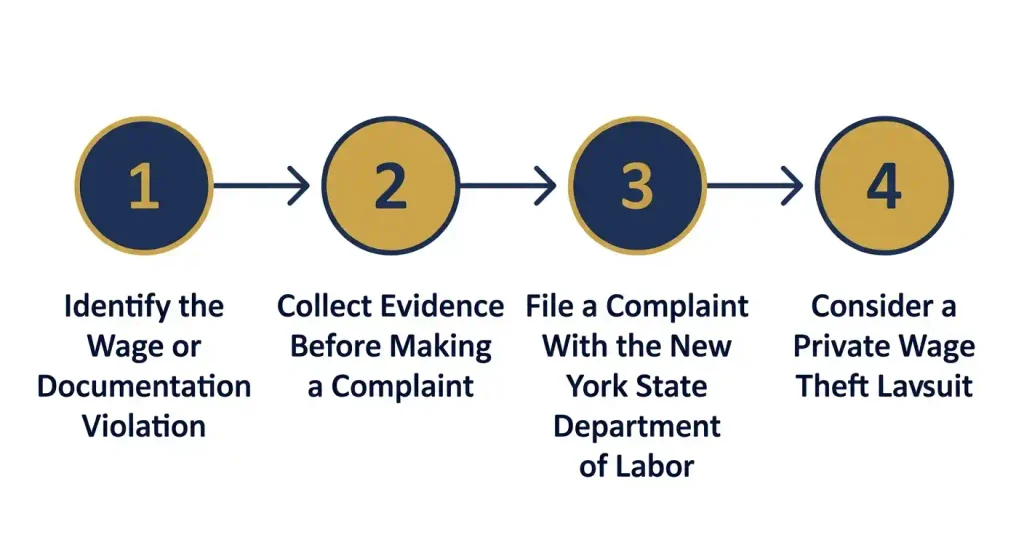
Step 1: Identify the Wage or Documentation Violation
Compare your pay agreement, hiring notice, and recent paystubs. Look for a missing notice, wrong rate, unexplained deduction, or unpaid hours to see if it is a paperwork problem, a money problem, or both. Raising it with your employer first is optional, never required before filing.
Step 2: Collect Evidence Before Making a Complaint
Save paystubs, your employment agreement, schedules, time records, bank deposits, emails, texts, and pay-change notices, and build a timeline of hours against wages. Without paystubs, your own notes and bank deposits still count, and NYSDOL can demand employer records during an investigation.
Step 3: File a Complaint With the New York State Department of Labor
NYSDOL’s Division of Labor Standards handles complaints through Labor Standards Complaint Form LS223, covering unpaid wages, overtime, deductions, and missing paystubs or notices. No lawyer is required and filing is free. NYSDOL investigates, contacts your employer, and some cases resolve through mediation or settlement. You can request confidentiality, and an ignored NYSDOL order can lead to liens, levies, or wage warrants. If your issue is specifically a missing check rather than missing paperwork, our guide on what to do when your New York paycheck is late covers the next steps.
Step 4: Consider a Private Wage Theft Lawsuit
A private lawsuit can run alongside or instead of an administrative complaint, sometimes with remedies an agency complaint lacks. You can generally pursue a state claim and a federal Fair Labor Standards Act (FLSA) claim together, though filing with NYSDOL can affect your lawsuit options, so check first. An employment attorney can help weigh recovery against cost, especially for larger claims.
How Long Do Employees Have to File a Wage Theft Claim?
New York gives you six years to bring a wage claim. Federal claims under the Fair Labor Standards Act (FLSA), enforced by the U.S. Department of Labor (DOL), have shorter windows, often two or three years depending on willfulness. NYSDOL’s acceptance rules can differ slightly from court deadlines.
How Employers Can Comply With the New York WTPA in 2026
New-Hire Wage Notice Compliance Checklist
Give every new hire a written notice with all required details before their first shift, using the matching NYSDOL form and available translation, and keep signed, dated acknowledgments on file.
Paystub and Payroll Record Compliance
Issue a complete wage statement with every payment, keep accurate real-time payroll records instead of reconstructing them later, and retain everything for at least six years.
Pay Rate Changes and Employee Notifications
Follow the seven-day advance notice rule, review overtime rates, allowances, and paystubs after every change, and fix payroll errors fast.
Internal Payroll Audits and Violation Prevention
Audit classifications, time records, deductions, and overtime math regularly, watch for missing notices and incomplete statements, and document any corrections.
Official New York Wage Theft Prevention Act Resources
New York Labor Law and Official Legal Text
Core provisions sit in New York Labor Law Section 195, New York Labor Law Section 198, and New York Labor Law Section 215, within New York Labor Law Article 6. Full bill text is available through New York State Senate Open Legislation. The federal Fair Labor Standards Act (FLSA) also applies alongside state law.
Official NYSDOL Forms and Employee Guidance
NYSDOL publishes the Notice of Pay Rate forms and instructions, the Wage Theft Prevention Act Fact Sheet P715, the NYSDOL Wage Theft Prevention Act FAQ, and Labor Standards Complaint Form LS223 with its Instructions for Filing a Claim LS223.2. NYSDOL’s Wage Theft Hub brings these together. For broader coverage of pay rules, browse our New York wage and labor law guides.
Frequently Asked Questions About the New York Wage Theft Prevention Act
Does New York require employers to provide a pay notice every year?
No. The annual requirement was repealed when Governor Cuomo signed the amendment on December 29, 2014, ending the February notice cycle starting in 2015. New-hire and pay-change notices still apply.
Can I sue my employer for not giving me a paystub?
Yes, under certain conditions, you may be entitled to statutory damages through an administrative complaint or a private lawsuit.
How much can I recover for a missing paystub in New York?
Up to $250 per workday, capped at $5,000 per employee, subject to statutory conditions and employer defenses.
Does my employer have to give me a pay notice in my native language?
Yes, if NYSDOL has an official translation, plus English in all cases.
Can my employer change my hourly wage without telling me?
No. Written notice is required at least seven calendar days before the change, unless it already appears on your wage statement.
How many years must New York employers keep payroll records?
Six years, covering payroll records, pay notices, and signed acknowledgments.
Can I report wage theft without losing my job?
Yes. Section 215 protects against retaliation, whether you complain internally or file a formal complaint.
Where do I report wage theft in New York?
The NYSDOL Division of Labor Standards, using Labor Standards Complaint Form LS223.

Meet Yasin Ali, Founder
Yasin built NY Paycheck Calculator in 2020 after getting fed up with calculators that treated New York like every other state. Most tools ignore the extra local tax NYC and Yonkers workers pay on top of state tax — or skip New York’s Paid Family Leave deduction entirely.
He keeps the numbers current, checking in regularly against the latest IRS, NY Department of Taxation and Finance, and Paid Family Leave rates.
All results here are estimates based on official sources. For advice specific to your situation, talk to a tax professional.