
A New York pay stub breaks down your hours, gross pay, taxes, and deductions, so you can see exactly what separates your earnings from your deposit, especially with New York’s added city and Yonkers tax layers.
That extra city and Yonkers layer is exactly what this guide breaks down section by section, from taxes to deductions to net pay.
Tax rates and wage thresholds shift every year, so always check them against your current pay stub.
What to Check on Your New York Pay Stub First
Check the dates, the names, and whether a number is current or year to date, before anything else.
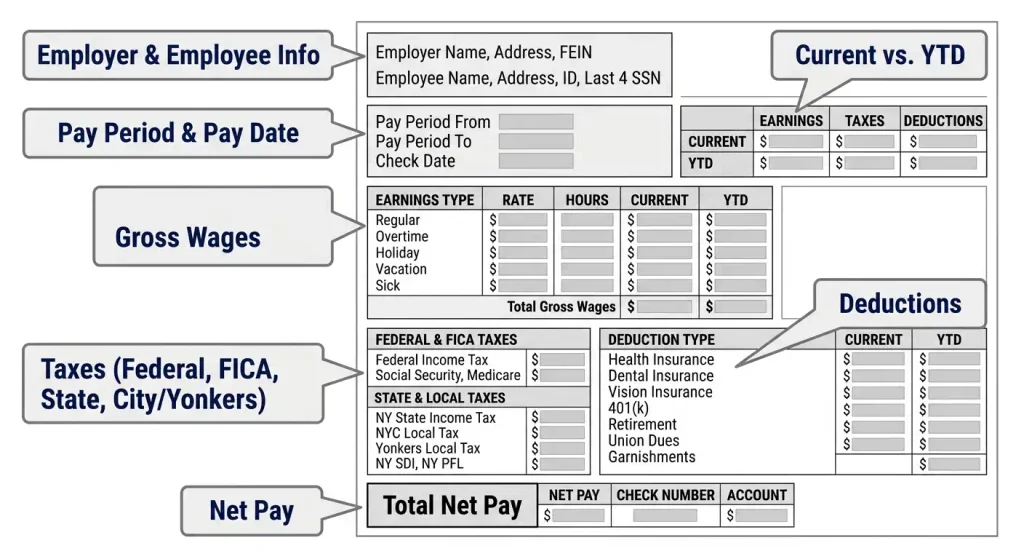
Find the Pay Period and Pay Date
The pay period is the days you worked. The pay date is when the money lands, usually a few days later. Check both against your normal schedule, weekly, biweekly, or semi-monthly.
Confirm Your Employer and Employee Information
Your stub must list your employer’s legal name, address, and phone number, plus your own name, under Labor Law §195.3. A payroll provider like ADP or Paychex may appear too. Confirm the stub matches the right job if you hold more than one.
Know Which Numbers Are Current and Which Are YTD
Current numbers reset each paycheck. YTD, year to date, keeps growing since January 1 and should never drop except for a correction. Don’t expect YTD to equal your current pay times the number of periods, since raises, bonuses, and missed time all change it. A first paycheck can also look different, since benefit deductions sometimes start a few checks in, once a waiting period ends.
How to Read the Earnings Section
This section builds your gross pay, hour by hour and rate by rate.
Find Your Pay Rate
Check your hourly or salary rate, and which one applies to you. Compare it to your hire or raise agreement. New York requires every rate to be listed if you work more than one type of shift. A raise should show on your very next stub after it takes effect.
Check Regular Hours Worked
Compare your regular hours to your timesheet. Unpaid meal breaks are a common, legal reason for a gap. A missing shift may just be a payroll cutoff issue, so check the dates first.
Check Overtime Hours and Overtime Pay
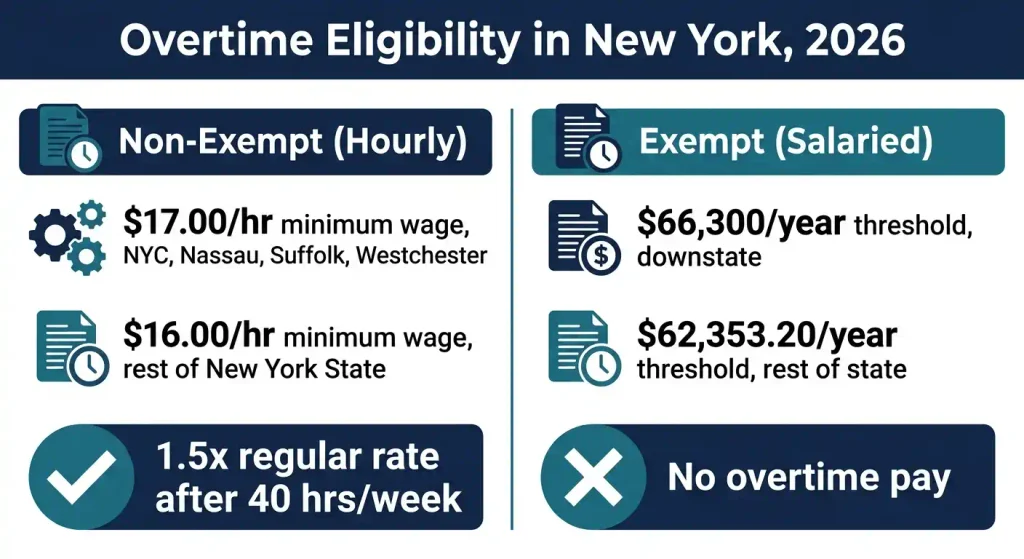
New York overtime law, matching the federal Fair Labor Standards Act (FLSA), requires 1.5 times your regular rate for hours over 40 in a week. It should list separately from regular hours. A heavy overtime week can push that period’s withholding higher, since the formula treats a bigger check as your new normal pay. Non-exempt workers, generally hourly employees paid at or above the New York minimum wage, which is set as the New York State minimum wage for their region ($17.00 an hour in NYC, Nassau, Suffolk, and Westchester, $16.00 an hour elsewhere in 2026), get this overtime. Exempt employees, usually salaried roles above a set income threshold ($66,300 a year downstate, $62,353.20 a year elsewhere in 2026), typically don’t.
Understand Other Earnings
Bonuses, commissions, tips, and allowances appear as separate lines. Check whether they’re added into gross wages or shown for reference only. Tip credits reduce what your employer owes directly, so they show as a credit, not an addition.
How to Calculate Gross Pay From Your Pay Stub
Rebuild gross pay yourself with basic math, the fastest way to catch an error.
Calculate Regular Earnings
Multiply hours by rate. Salaried pay is usually a flat number instead. A mismatch usually means a wrong hour or rate entry. Our New York paycheck calculator can estimate your next check once you know your rate.
Calculate Overtime Earnings
Multiply overtime hours by 1.5 times your regular rate. If you work multiple pay rates, New York requires a weighted average for the overtime calculation, not your lowest rate.
Add Other Earnings to Reach Gross Pay
Add regular pay, overtime, and anything else like bonuses. The total should match your gross wages line. If not, check for a missed earnings category first.
How to Read Taxes on a New York Pay Stub
Up to four tax withholdings can appear: federal, FICA, state, and sometimes city or Yonkers.
Federal Income Tax Withholding
This is an estimate, not your final bill, based on your Form W-4, the Employee’s Withholding Certificate. It can change any time you update that form.
Social Security and Medicare Taxes
Social Security and Medicare make up FICA. In 2026, you pay 6.2% toward Social Security up to the $184,500 wage cap, tracked by the Social Security Administration, and 1.45% toward Medicare with no cap. These are flat federal rates, separate from New York tax.
New York State Income Tax Withholding
New York State income tax runs 3.9% to 10.9%, based on Form IT-2104, the New York State Employee’s Withholding Allowance Certificate, using withholding table NYS-50-T-NYS from the New York State Department of Taxation and Finance.
New York City Income Tax Withholding
NYC tax applies only to NYC residents, using table NYS-50-T-NYC. City residents will typically see both federal and New York City withholding on the same stub. Moving into or out of the city means updating IT-2104, as covered under updating your withholding forms below. Form IT-2104.1, the Certificate of Nonresidence and Allocation of Withholding Tax, applies to specific residency-allocation cases.
Yonkers Income Tax Withholding
Yonkers tax applies only to Yonkers residents or certain workers there, using table NYS-50-T-Y. Most New Yorkers never see this line.
How to Read Deductions on a New York Pay Stub
Deductions are anything taken out that isn’t a tax.
Understand Mandatory Payroll Deductions
These include garnishments, disability insurance, and Paid Family Leave, at 0.432% of gross wages per pay period, capped at $411.91 a year in 2026. They’re required, but separate from taxes.
Understand Pre-Tax Deductions
These lower taxable wages before certain taxes apply, like 401(k) or health premiums. Pre-tax isn’t tax-free forever, since retirement withdrawals get taxed later.
Understand After-Tax Deductions
These come out after taxes, so taxable income stays the same. Roth 401(k) is a common example. Check unfamiliar ones against your benefits enrollment.
Check Benefits and Other Payroll Deductions
Health insurance, retirement, union dues, and commuter benefits are common lines. New York bans mandatory uniform or shortage deductions without a signed agreement. Garnishments are legally required regardless of preference.
Why Gross Pay, Taxable Wages, and Net Pay Can Be Different
These three numbers rarely match, and that’s normal.
Gross Pay vs. Taxable Wages
Pre-tax deductions lower taxable wages below gross pay. Different taxes can use different taxable bases, so figures may vary even within one stub.
Gross Pay vs. Net Pay
Gross pay minus every tax and deduction equals net pay, your actual take-home amount.
Net Pay vs. Bank Deposit
Net pay should match your deposit unless it’s split across multiple accounts. Check the combined total, not just one account.
A New York Pay Stub Example: Read It Line by Line
Real numbers make the math click.
Example Employee Earnings
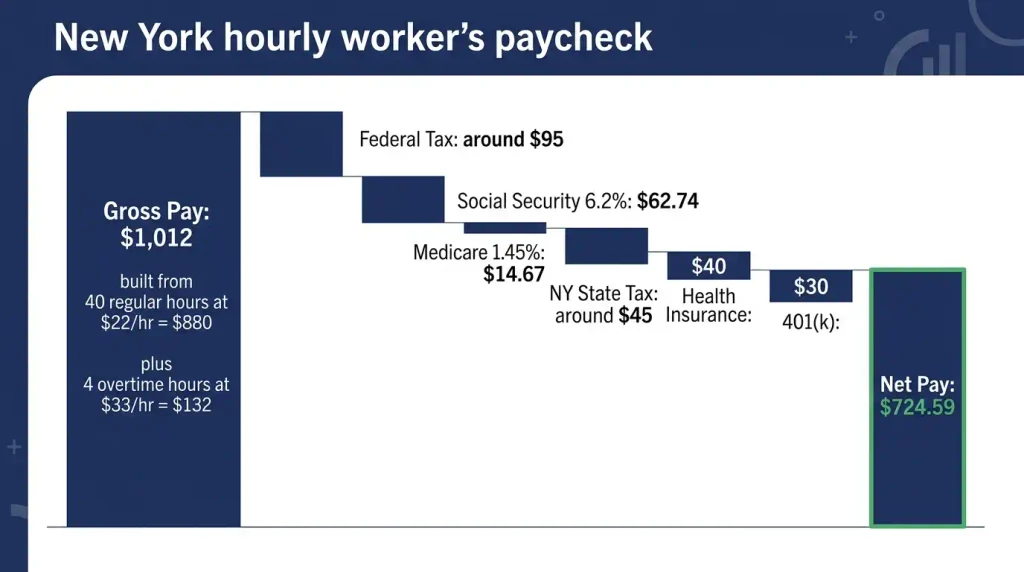
An hourly worker in Queens at $22 an hour works 44 hours: 40 regular hours ($880) plus 4 overtime hours at $33 ($132). Gross pay: $1,012.
Example Tax Withholding
On $1,012: federal withholding around $95, Social Security 6.2% ($62.74), Medicare 1.45% ($14.67), New York State withholding around $45 under 2026 tables. No NYC or Yonkers tax applies here.
Example Deductions and Net Pay
A $40 health premium and $30 401(k), both pre-tax, come out too. Net pay lands around $724.59.
Example Current Pay vs. YTD
At week 10, current pay is $1,012, but YTD reflects all 10 weeks combined. YTD tax withholding adds up the same way. It’s a running total, not a new deduction.
New York State vs. New York City vs. Yonkers Pay Stubs
Two employees, same job, different stubs, usually based on residence.
New York State Tax vs. New York City Tax
State tax applies to every New York employee. City tax applies only to NYC residents, calculated separately, not as an add-on percentage.
New York State vs. NYC vs. Yonkers Withholding
Form IT-2104 sets all three based on residency.
| Residence | Withholding that applies |
|---|---|
| Buffalo (rest of NYS) | State tax only |
| Manhattan (NYC) | State tax plus NYC tax |
| Yonkers | State tax plus Yonkers tax |
Why Two New York Employees Can Have Different Pay Stubs
Withholding elections, benefit enrollments, pay rates, overtime, and bonus timing all vary, so no two stubs need to match.
How Your W-4 and IT-2104 Affect Your Pay Stub
These two forms control most of the tax side of your stub.
What Form W-4 Controls
Your W-4, the Employee’s Withholding Certificate, sets federal withholding based on filing status and dependents. It has no effect on New York, city, or Yonkers tax.
What Form IT-2104 Controls
IT-2104, the New York State Employee’s Withholding Allowance Certificate, sets state, NYC, and Yonkers withholding based on residency answers. The 2026 version reflects current brackets. Your first stub after a job change or a new W-4 or IT-2104 can look different simply because new settings just started.
When a New York Employee May Need to Update IT-2104
Update it for a new job, a move into or out of NYC or Yonkers, or major life changes like marriage or a new dependent. An outdated form is a common cause of a surprise tax bill.
Common Myths About New York Pay Stubs
“Gross Pay Is the Money I Take Home”
Gross pay is before deductions. A $1,000 gross paycheck might net only $760.
“A Higher Tax Withholding Means I Was Taxed at That Rate”
Withholding is an estimate, not your tax rate. A raise increases withholding because the paycheck is bigger, not because the whole check got taxed at a higher rate.
“Every New York Worker Should Have NYC Tax on Their Pay Stub”
NYC tax applies only to city residents, not everyone working there. A New Jersey commuter into Manhattan won’t see it.
“YTD Means I Owe That Amount”
YTD is a running record of what’s already been paid or withheld, not a bill you still owe.
“Every Deduction on a Pay Stub Is a Tax”
Health insurance, 401(k), and union dues are deductions, not taxes.
“The Amount on My Pay Stub Must Equal My Bank Deposit”
A split-account deposit won’t match net pay in any single account. Check the combined total.
What to Do If Your New York Pay Stub Does Not Match Your Pay
If a required field, like pay period dates or employer address, is missing entirely, that’s a Section 195.3 compliance issue on its own.
Ask Payroll the Right Questions
Name the exact line that’s wrong. Ask for the calculation. Request it in writing for bigger discrepancies.
Keep Evidence of Your Pay
Save every stub, timesheet, offer letter, and bank record. Your final stub of the year should match your W-2 Wage and Tax Statement, since the IRS uses that form to confirm your earnings and tax.
When a Payroll Problem May Be More Serious
One wrong hour may be a slip. Repeated underpayment, missing overtime, or unauthorized deductions are patterns worth escalating. New York allows damages up to $250 per workday, capped at $5,000 per employee, for wage statement violations.
Where New York Workers Can Seek Help
The New York State Department of Labor, also called the New York Department of Labor or NYSDOL, handles wage complaints. Rules come from Labor Law §195.3, alongside the wage-notice forms in the LS 54 through LS 59 series required under §195.1, both strengthened by the Wage Theft Prevention Act. NYSDOL’s fact sheet, Wage Statement (pay stub): Required Information under Section 195.3, lists exactly what’s required. General NYSDOL information isn’t a substitute for an employment attorney.
New York Pay Stub Reading Checklist
Check Earnings
- Pay period and pay date
- Regular hours and rate
- Overtime hours and rate
- Gross wages
Check Taxes and Deductions
- Federal and FICA withholding
- Any New York State, NYC, or Yonkers withholding
- Benefit deductions
- Current versus YTD amounts
Reconcile the Final Pay
- Gross wages
- Minus taxes and deductions
- Equals net pay
- Matched against your deposit
Common New York Pay Stub Problems and What They Can Mean
The Hours on the Pay Stub Are Wrong
Check missing regular or overtime hours, then payroll cutoff dates, then your own timesheet.
The Pay Rate Is Lower Than Expected
Compare it to your offer letter or raise notice and check the effective date.
The Net Pay Is Lower Than Expected
Confirm gross pay first, then check withholding changes, new benefit deductions, or one-time adjustments.
A Deduction Looks Unfamiliar
Check its category, your benefits enrollment, and whether you authorized it in writing.
Overtime Is Missing or Looks Incorrect
Compare hours and rate to your records. If unresolved, NYSDOL is the next step.
Frequently Asked Questions About New York Pay Stubs
What information must be on a New York pay stub?
Labor Law §195.3 requires pay period dates, names and addresses, pay rates, hours, gross wages, deductions, and allowances like tip credits.
Why is my net pay lower than my gross pay?
Taxes and deductions, mandatory or voluntary, pre-tax or after-tax, come out between the two.
Why is New York State tax on my paycheck?
Every New York employee has state tax withheld under Form IT-2104, at rates from 3.9% to 10.9%, as an estimate toward final liability.
Why do I have New York City tax withheld from my paycheck?
Only NYC residents pay it, separate from state tax, regardless of where they work.
What does YTD mean on a pay stub?
Year to date, a running total since January 1 for earnings, taxes, and deductions.
Why are my taxable wages different from my gross wages?
Pre-tax deductions lower taxable wages. Different taxes can use different taxable bases.
How do I know if my paycheck is correct?
Match hours and rate to your records, then recalculate gross to net.
What should I do if my pay stub is wrong?
Document the exact line, contact payroll, keep records, and use NYSDOL if unresolved.
Final New York Pay Stub Check
The Five Numbers to Verify Before You Move On
Hours worked, pay rate, gross pay, taxes and deductions, net pay, checked in order.
When Your Pay Stub Looks Right
Gross to net adds up, current and YTD align. Keep it for tax season and future comparisons.
When Something Does Not Look Right
Pin down the exact discrepancy, compare it to your records, ask payroll for the calculation, and escalate to NYSDOL only if it stays unresolved.

Meet Yasin Ali, Founder
Yasin built NY Paycheck Calculator in 2020 after getting fed up with calculators that treated New York like every other state. Most tools ignore the extra local tax NYC and Yonkers workers pay on top of state tax — or skip New York’s Paid Family Leave deduction entirely.
He keeps the numbers current, checking in regularly against the latest IRS, NY Department of Taxation and Finance, and Paid Family Leave rates.
All results here are estimates based on official 2026 sources. For advice specific to your situation, talk to a tax professional.